A Board’s Guide to Ecommerce Governance
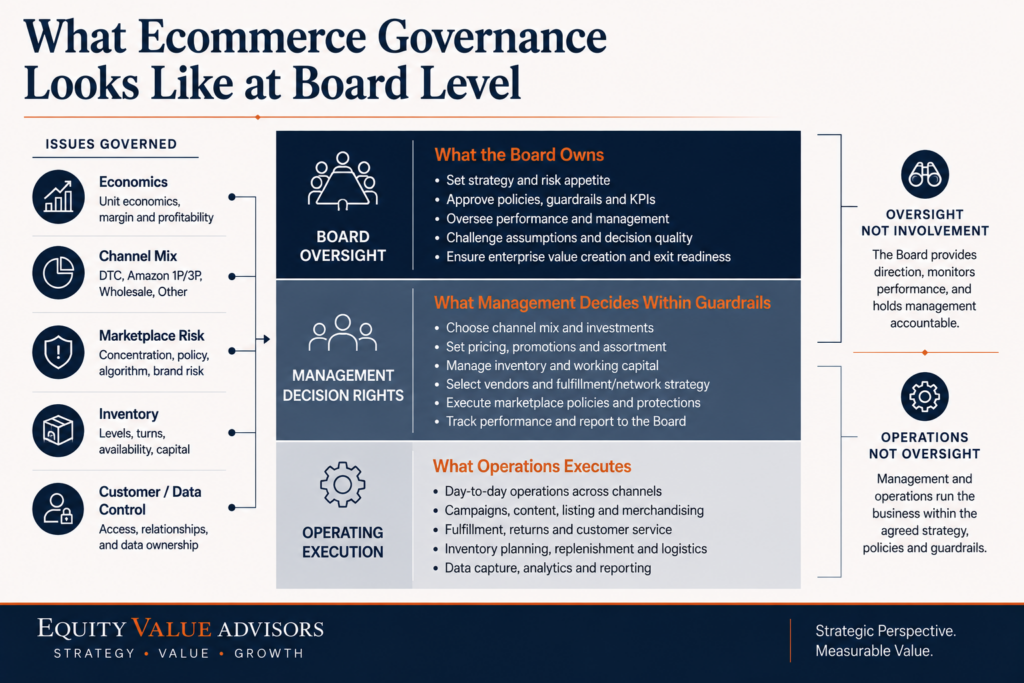
Ecommerce board governance is the system by which directors oversee the economics, risks, decision rights and dependencies created by digital channels without assuming management’s operating responsibilities. Good governance gives the board visibility into contribution, concentration, inventory, channel control and major platform risks while keeping execution clearly with management and ensuring material ecommerce decisions support the company’s investment thesis.
Ecommerce governance is not ecommerce management
It is not the board reviewing campaign tactics, ASIN details or weekly conversion rates. The distinction matters because boards can become overinvolved in visible digital activity while still missing the structural questions that matter.
The Board Ecommerce Health Check
I use six dimensions to frame the board conversation: economics, channel control, concentration, inventory, governance and exit readiness. A company does not need to be perfect on all six. The board does need to know where weakness is becoming material.
1. Economics
Can the board see contribution by major channel after marketplace fees, fulfillment, advertising, returns and channel-specific costs? Revenue and gross margin are insufficient if the economics that differ by channel are hidden in functional budgets.
2. Channel control
Does the company know who is selling its products, where inventory is leaking and whether distributors or unauthorized sellers are undermining pricing, assortment or advertising efficiency? Channel control is not purely a legal issue. It can change the economics of every legitimate seller.
3. Concentration
What percentage of revenue, profit or inventory exposure depends on Amazon, Walmart, Shopify, a small number of ASINs or a single logistics partner? Concentration is not automatically bad. Unmeasured concentration is.
4. Inventory
Is inventory treated as a strategic asset or simply an operating requirement? Excess stock, stockouts, aging inventory and channel imbalance can destroy cash conversion and force bad commercial decisions.
5. Governance
Who owns channel decisions? Are sales, ecommerce, finance, operations and marketing measured against compatible outcomes? If every function can improve its own KPI while total enterprise economics deteriorate, governance is weak.
6. Exit readiness
Could management explain the company’s ecommerce economics, channel risks and operating controls clearly to a sophisticated buyer tomorrow? If not, the company is accumulating diligence debt.
What belongs in the boardroom
The board should focus on changes in the six dimensions, material exceptions and decisions that affect the investment thesis. The operating team should own the detailed actions. This creates a governance cadence that is useful without being intrusive.
| Board | Management |
|---|---|
| Sets oversight expectations | Executes |
| Reviews economics | Operates channels |
| Challenges assumptions | Chooses tactics |
| Monitors concentration | Manages accounts |
| Reviews capital allocation | Deploys capital |
The practical test
If ecommerce is material to enterprise value but the board cannot answer whether digital growth is economically attractive, controlled, diversified, inventory-efficient and diligence-ready, ecommerce governance needs work.
Related Questions
I work with PE sponsors, CEOs and boards where ecommerce, marketplaces or channel complexity can materially affect enterprise value. If that is a capability gap on your board, I am always interested in comparing notes.
James Thomson – former Amazon executive, four successful exits, board member/investor, and author of two books on marketplace governance and brand strategy.
Agentic Commerce Governance
As AI shopping agents become material, boards should focus on ownership, economics, customer-data implications and platform dependency rather than technical implementation. See Agentic Commerce Governance.
The Agentic Commerce Brief
What changed in agentic commerce, and what it means for brands.
A concise weekly brief for brand executives navigating the shift from human-led shopping to agent-mediated commerce. Follow the developments that matter, the implications for brand control and governance, and the questions senior teams should be asking now.
Read The Agentic Commerce Brief on SubstackIf the signup form does not load, subscribe directly on Substack.