James Thomson: Board Member, Investor and Ecommerce Operator
James Thomson is a former Amazon executive, ecommerce operator, author, investor and independent board member focused on PE-backed consumer, ecommerce and marketplace businesses. His work centers on ecommerce economics, marketplace governance, channel control, platform concentration, operating dependencies and transaction readiness, translating hands-on marketplace experience into board-level questions about risk, capital allocation and enterprise value. He has written two books for executives dealing with Amazon and marketplace strategy.
Who I am
Most of my career has been spent at the intersection of ecommerce, marketplaces, company building and governance. Those experiences matter because a board seat is not an advisory engagement with a different title.
The job is to help management and owners make better decisions, maintain the right level of oversight and protect long-term enterprise value without drifting into management’s role.
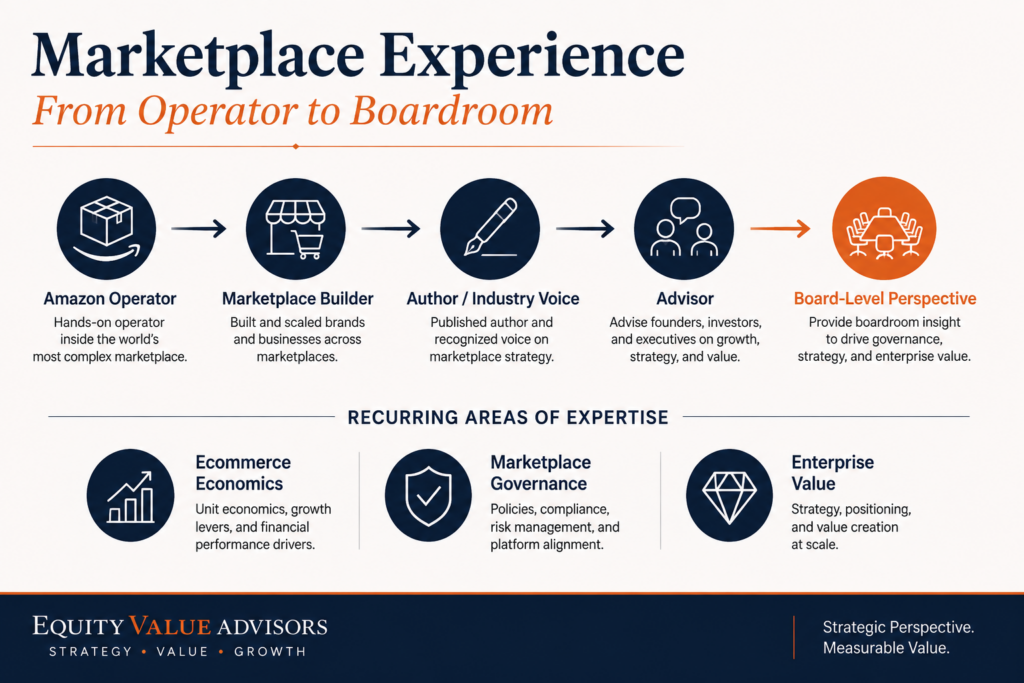
From building Amazon marketplace capabilities to governing marketplace risk
I led Amazon Services and served as Amazon’s first Fulfillment by Amazon account manager.
During the early development of FBA, my work included convincing marketplace sellers that Amazon’s fulfillment infrastructure could become part of their growth strategy.
Years later, The New York Times revisited that period in its examination of Amazon’s evolving relationship with marketplace sellers. The article described my role leading teams that recruited sellers into Amazon’s fulfillment network. I recalled bringing merchants through Amazon facilities and telling them:
As Prime became more important, the value proposition evolved. Prime eligibility increasingly became intertwined with fulfillment by Amazon.
That experience gave me a perspective I still use today: marketplace capabilities that initially create extraordinary growth can eventually become important dependencies that management and boards need to understand.
Experience on both sides of the marketplace equation
After Amazon, I built Buy Box Experts into a 300-plus-person ecommerce agency serving brand clients representing more than $3 billion in marketplace GMV before the business was sold to Spreetail in 2021. I have written two books to help executives think about the Amazon channel.
I have also been involved in successful exits involving Skubana, Fakespot, and The Prosper Show.
Over the years, major publications have repeatedly sought my perspective on the commercial consequences of Amazon’s marketplace model. For example, I explained to The New York Times why Amazon’s access to shopper behavior gives it information individual brands do not possess:
“Amazon has access to data that nobody else has.”
That distinction between participating in a marketplace and controlling the marketplace relationship is central to how I now think about governance.
What I bring to a board
I am most useful when ecommerce, marketplaces, channel complexity or operating scale have become sufficiently material to affect enterprise value.
I understand the operating detail well enough to identify which questions matter.
But I do not believe a director should become a shadow operator.
Boards need pattern recognition.
Management may see:
- an Amazon problem
- an inventory problem
- a channel conflict
- increasing advertising spend
- a seller problem
A director should be able to connect those issues to economics, incentives, concentration, governance and ultimately enterprise value. My background provides that pattern recognition across marketplace operations, agency services, software, logistics, brand strategy and transactions.
The areas where I am most useful
- PE-backed consumer and ecommerce businesses where Amazon, Walmart, DTC or other digital channels materially affect revenue or margin
- marketplace and commerce-technology businesses navigating platform strategy and scale
- brands facing channel-control, unauthorized-seller or distributor-leakage issues
- companies preparing for transactions where operating discipline and diligence readiness affect value
- boards seeking an independent director who can challenge management constructively without competing with management
How I think about governance
I separate governance from operations. The board should make sure the company is using the right measures, seeing risk early enough, allocating capital rationally and making decisions consistent with the owners’ time horizon.
I also believe boards are most valuable before a problem becomes acute. A board that only reacts to misses, margin pressure or diligence findings is late. Good governance creates a cadence in which the company sees changes in economics, concentration, channel health and operating risk while management still has options.
A useful first conversation
If you are a PE partner, operating partner, CEO or board chair evaluating board composition, the first conversation should not start with my résumé.
It should start with the company:
What needs to be true over the next three years for the investment thesis to work?
Where could ecommerce or marketplace complexity interfere with that outcome?
What will the board eventually need to understand that it does not understand today?
Those questions usually make it clear whether my experience is relevant.
I work with PE sponsors, CEOs and boards where ecommerce, marketplaces or channel complexity can materially affect enterprise value. If that is a capability gap on your board, I am always interested in comparing notes.
Profile: LinkedIn
Email: james@jamesthomson.com
Substack: https://ecommerceboardmember2026.substack.com

The Agentic Commerce Brief
What changed in agentic commerce, and what it means for brands.
A concise weekly brief for brand executives navigating the shift from human-led shopping to agent-mediated commerce. Follow the developments that matter, the implications for brand control and governance, and the questions senior teams should be asking now.
Read The Agentic Commerce Brief on SubstackIf the signup form does not load, subscribe directly on Substack.