
How can ecommerce revenue growth destroy enterprise value?
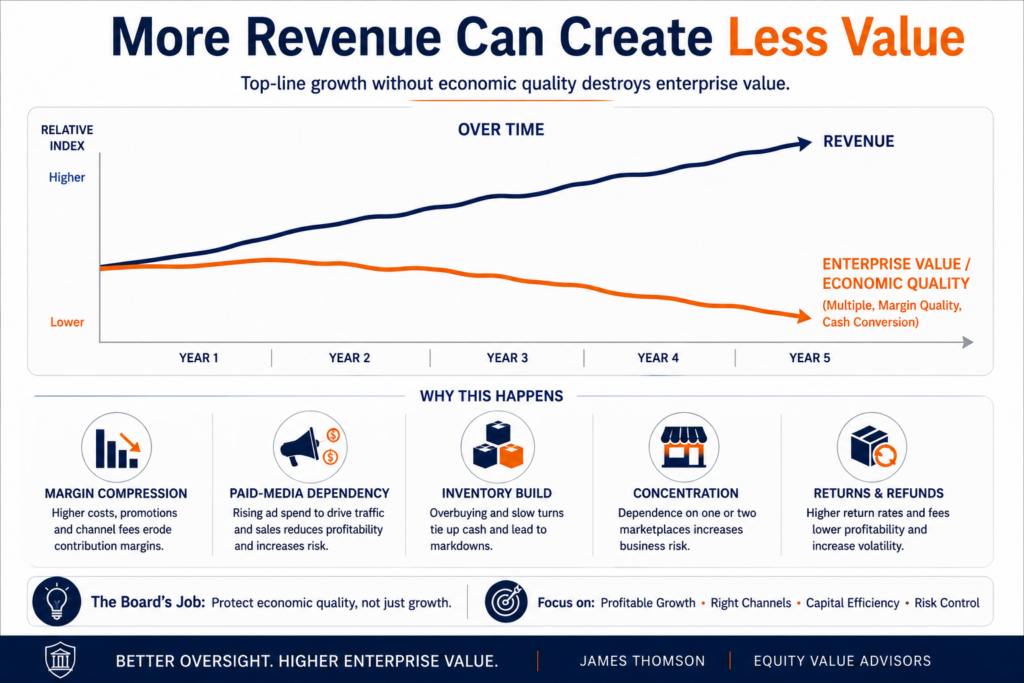
Short answer: Ecommerce revenue growth can destroy enterprise value when the incremental sales carry weak contribution, consume excessive working capital, increase concentration, depend on unsustainable paid acquisition, or create operating complexity that a future buyer discounts.
Growth can be economically expensive
A channel can produce strong topline growth while marketplace fees, returns, fulfillment, discounting, and advertising consume most of the incremental gross profit. Boards should understand the contribution of the next dollar of growth, not only the historic average.
Growth can consume cash
More SKUs, more locations, FBA placement, higher safety stock, and longer lead times can increase inventory faster than sales. If cash conversion weakens materially, the equity return can deteriorate even when EBITDA looks acceptable.
Growth can increase fragility
If most incremental revenue comes from one platform, hero SKU, ad channel, or agency, the company may become less resilient as it grows. A future buyer may discount the revenue if the dependency is difficult to transfer or mitigate.
Growth can weaken control
Aggressive wholesale sell-in, promotions, or inventory liquidation can create marketplace leakage and pricing pressure. Functional teams may hit their targets while the company loses channel control.
EVA perspective
The board should celebrate growth that improves contribution, cash generation, strategic flexibility, and transferability. Revenue growth is an input to enterprise value—not a substitute for it.
Related James Thomson resources
James Thomson helps PE sponsors, CEOs and boards govern ecommerce, marketplaces and channel complexity as enterprise-value issues.