
How should a board evaluate paid-media dependence in ecommerce?
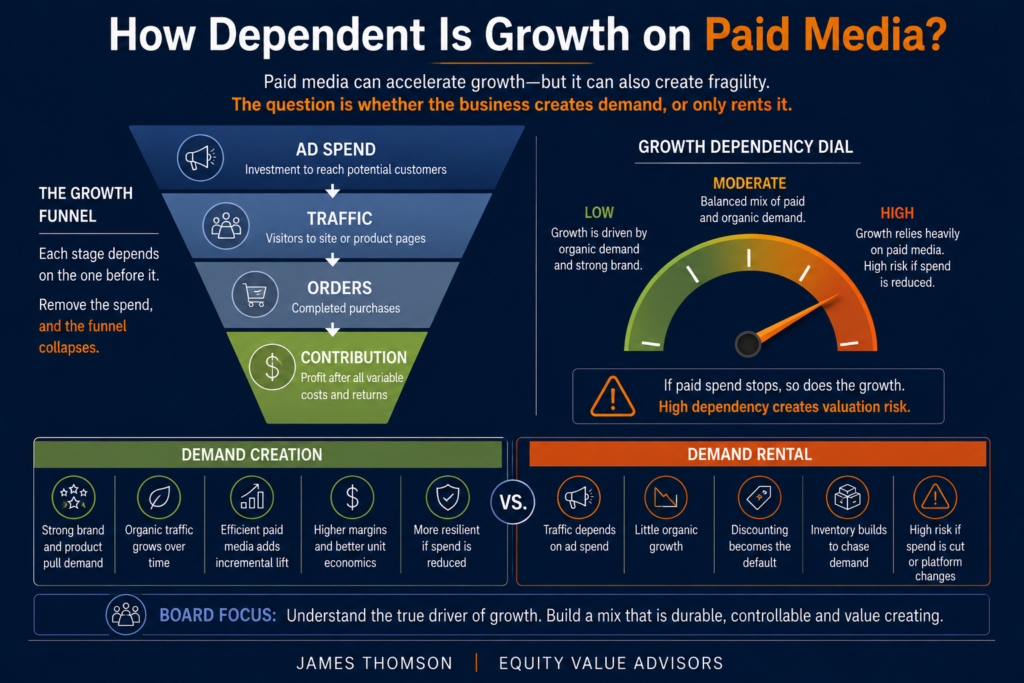
Short answer: Boards should evaluate paid-media dependence by asking how much revenue and contribution rely on paid acquisition, how efficiency is trending, and what happens if media economics deteriorate. The issue is not whether the company advertises; most ecommerce businesses should. The issue is whether growth becomes fragile without continued spend escalation.
Separate efficiency from dependence
ROAS or MER can describe current performance, but neither alone shows how dependent the business is on paid demand. The board needs to understand the share of new-customer revenue sourced through paid channels, how branded and non-branded demand behave, and whether organic or repeat demand is strengthening.
Use downside scenarios
A useful question is what happens if acquisition costs rise 20% or conversion falls. How quickly can spending be reduced? What revenue disappears? What contribution remains? Does inventory become excessive if demand generation slows? This connects media performance to cash and planning.
Watch for attribution comfort
Highly detailed attribution can create false confidence. Boards do not need to adjudicate attribution models, but they should know whether management’s investment decisions are robust to reasonable alternative views of incrementality.
Connect media to enterprise value
Paid media is more valuable when it builds repeat customers, organic demand, brand search, or a data asset the company controls. It is less defensible when each period starts from zero and requires more spend to reproduce the prior period’s sales.
EVA perspective
Treat paid acquisition as a concentration and capital-allocation issue. The board’s job is to understand whether media is financing durable demand or renting revenue at an increasingly expensive price.
Related James Thomson resources
James Thomson helps PE sponsors, CEOs and boards govern ecommerce, marketplaces and channel complexity as enterprise-value issues.