
How should a board measure ecommerce profitability?
Short answer: Boards should measure ecommerce profitability using a consistent contribution definition by material channel after channel-specific costs. Gross margin is usually too high in the P&L to reveal the economics that differ across Amazon, DTC, marketplaces, and wholesale ecommerce.
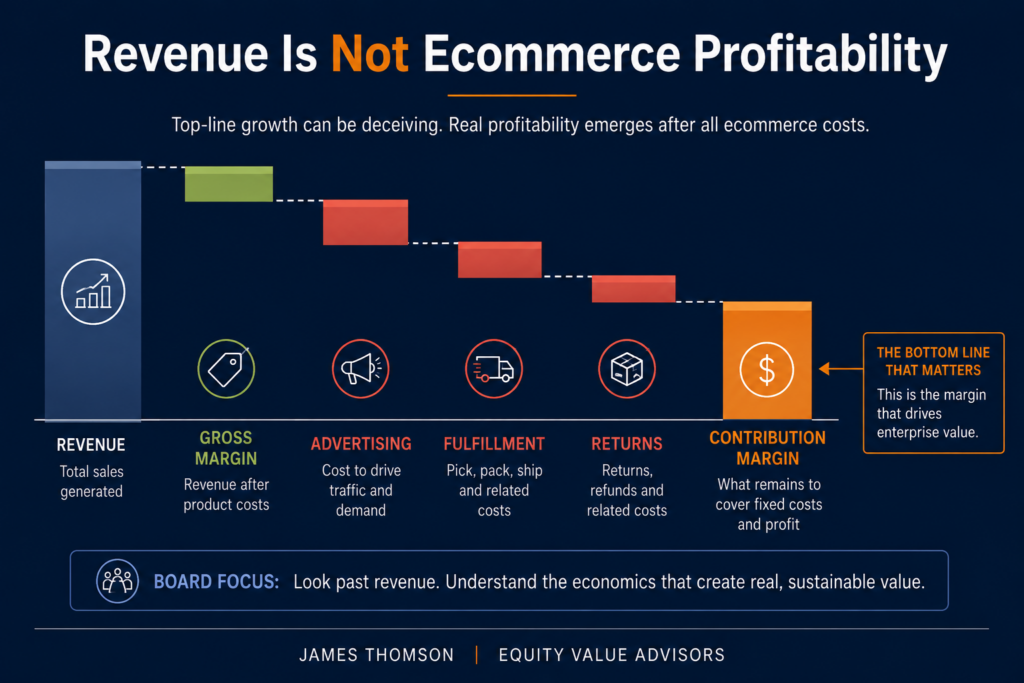
Start with a contribution bridge
For each material channel, reconcile revenue to gross profit and then deduct costs that are economically attributable to that channel: marketplace fees, fulfillment, freight, returns, discounts, chargebacks, payment costs, channel-specific labor where appropriate, and performance marketing when it is required to generate the sale.
Do not force false precision
The point is not to allocate every corporate overhead dollar to a channel. The point is to expose the major variable and semi-variable costs that management can influence. A contribution framework should be consistent enough to compare channels and to reconcile back to finance.
Separate growth from the cost of growth
Boards should distinguish existing-channel economics from incremental growth economics. If the next dollar of revenue requires substantially more media, inventory, discounting, or fulfillment complexity, the growth plan may produce a different return profile than the historic business.
Watch for accounting blind spots
A common warning sign is when marketplace fees sit in one function, advertising in another, fulfillment in operations, and returns elsewhere, leaving nobody accountable for the full channel economics. Another is when management can quote ROAS instantly but cannot reconcile contribution by channel.
EVA perspective
Revenue answers how much was sold. Contribution answers whether the channel is economically useful. Boards should insist on an agreed definition, trend it over time, and use it to evaluate major channel and capital-allocation decisions.
Related James Thomson resources
James Thomson helps PE sponsors, CEOs and boards govern ecommerce, marketplaces and channel complexity as enterprise-value issues.