Amazon Concentration Risk: A Board-Level Guide
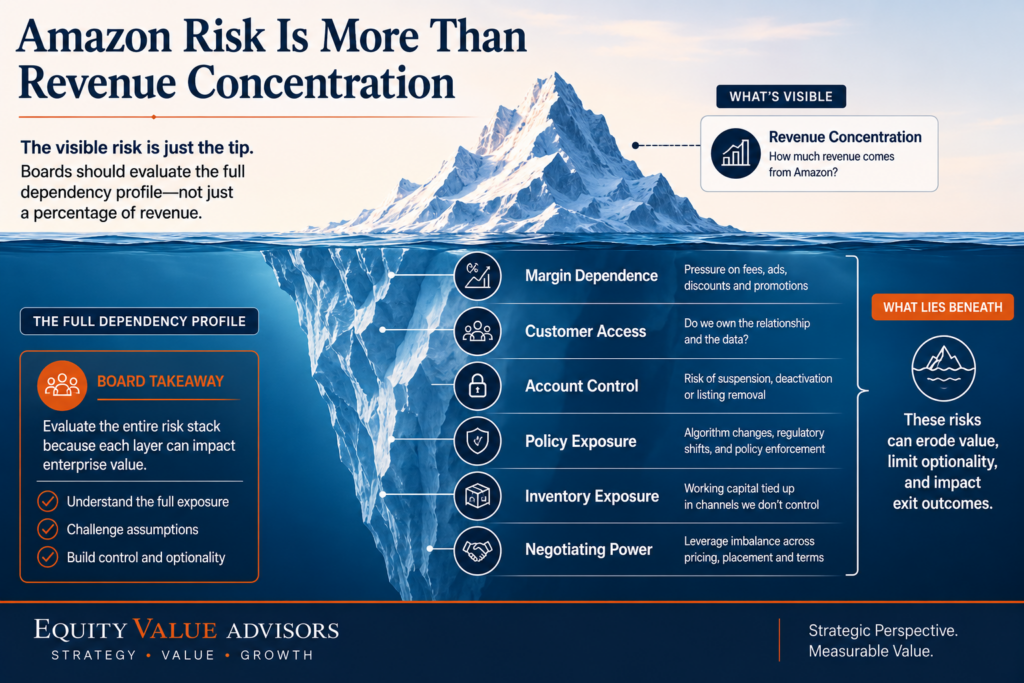
Amazon concentration becomes a board risk when a change in Amazon economics, visibility, policy, fulfillment or account access could materially affect earnings or the investment thesis. Revenue share alone does not determine the risk. Boards should also understand contribution concentration, inventory exposure, advertising dependence, customer access, account control and whether management has realistic alternatives if Amazon conditions change materially.
Amazon concentration is broader than revenue concentration
If Amazon represents 30 percent of company revenue, the board will notice. But the revenue percentage alone understates the dependency. A brand may also rely on Amazon for customer discovery, inventory velocity, advertising demand, product reviews, pricing reference points and cash conversion. It may have built internal processes, advertising capabilities and even organizational roles around the assumption that Amazon will continue to operate largely as it does today.
That is why I think boards should understand Amazon concentration as a system of dependencies, rather than a single percentage.
Platform dependence can become enterprise risk
The underlying governance issue is control.
A company can control its products, employees and capital allocation. It has much less control over a marketplace’s algorithms, fees, account policies, search placement or strategic priorities.
I discussed this dynamic with The New York Times in 2021 while the newspaper was examining how Amazon and other large platforms controlled access to customers. Amazon’s decisions in that case were consistent with its longstanding emphasis on keeping consumers within the Amazon ecosystem. As I told the Times:
“The problem is, if they allow these practices to scale up,
it becomes disruptive to anything else that isn’t Amazon.”
Six forms of Amazon concentration
Revenue concentration: How much sales volume depends on Amazon?
Contribution concentration: How much absolute contribution comes from the channel
SKU concentration: Does a small number of ASINs drive a disproportionate share of performance?
Inventory concentration: How much working capital is committed to Amazon-specific inventory?
Demand concentration: Has Amazon become the company’s primary source of customer discovery?
Operational concentration: Do accounts, advertising, fulfillment, data or critical knowledge depend heavily on Amazon or a small number of employees?
The wrong board question
The wrong question is:
“Should we reduce Amazon?”
A strong and profitable channel should not be weakened merely to make a concentration chart look better.
The more useful question is:
“What happens to the investment thesis if Amazon economics, policies or performance change materially?”
That changes the discussion from arbitrary diversification to resilience.
Scenario testing
I would ask management to model several plausible shocks:
- a meaningful increase in marketplace fees
- a sustained decline in conversion
- loss of Buy Box visibility on important products
- temporary account disruption
- materially higher advertising costs
- changes in fulfillment economics
- reduced organic discoverability
- a policy change affecting assortment, pricing or sellers
The board does not need to predict which event will happen.
It needs to know whether management has options if one does.
Risk can be worth accepting
Concentration can be entirely rational when Amazon delivers attractive economics and the company understands the dependency it is accepting.
The governance problem is not concentration itself.
It is concentration that is poorly measured, poorly understood or implicitly assumed to be permanent.
What good governance looks like
A board should see concentration trends, channel contribution, critical dependencies and mitigation choices. Management should be able to distinguish between risks it deliberately accepts because the economics justify them and risks it is actively reducing. That is a much more useful governance discussion than establishing an arbitrary Amazon revenue ceiling.
I work with PE sponsors, CEOs and boards where ecommerce, marketplaces or channel complexity can materially affect enterprise value. If that is a capability gap on your board, I am always interested in comparing notes.
James Thomson – former Amazon executive, four successful exits, board member/investor, and author of two books on marketplace governance and brand strategy.
The Agentic Commerce Brief
What changed in agentic commerce, and what it means for brands.
A concise weekly brief for brand executives navigating the shift from human-led shopping to agent-mediated commerce. Follow the developments that matter, the implications for brand control and governance, and the questions senior teams should be asking now.
Read The Agentic Commerce Brief on SubstackIf the signup form does not load, subscribe directly on Substack.