When Ecommerce Growth Creates Enterprise Value, and When It Doesn’t
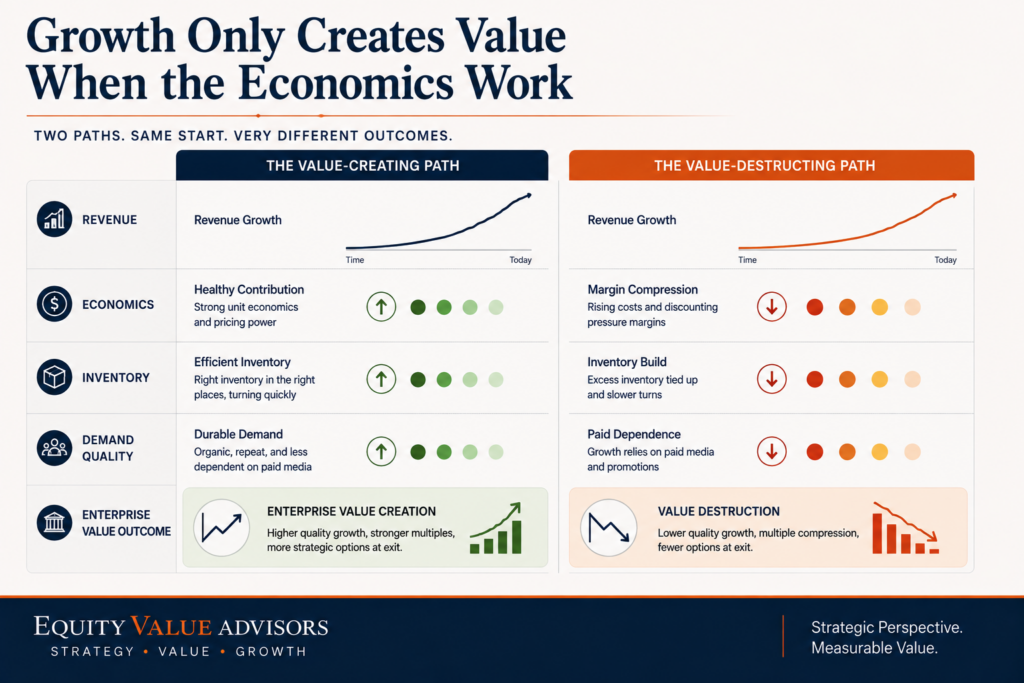
Ecommerce growth creates enterprise value only when incremental revenue produces attractive contribution, reasonable working-capital requirements and durable customer demand without creating excessive channel or platform concentration. Revenue can rise while economic quality deteriorates through higher advertising costs, weaker margins, inventory build or returns. Boards should therefore evaluate the quality and resilience of growth, not simply whether ecommerce sales are increasing.
Not all growth deserves the same multiple
Boards often receive growth as a single number. That is convenient and frequently misleading. Two dollars of incremental revenue can have very different implications for enterprise value depending on contribution, working capital, concentration, repeatability and the amount of management effort required to sustain them.
The board should therefore evaluate the quality of ecommerce growth, not only its rate.
Five tests for quality of growth
- Contribution: Does the incremental revenue produce attractive contribution after channel-specific costs?
- Durability: Does growth depend on one promotion, one retailer, one marketplace policy or temporary media efficiency?
- Working capital: How much inventory and cash must be committed to create the growth?
- Concentration: Does growth make the business more dependent on one platform, customer or SKU?
- Transferability: Could a future owner understand and continue the growth engine without relying on one person or undocumented relationships?
Why revenue can outrun value
A company can increase marketplace sales by spending more on advertising, accepting worse fulfillment economics, adding low-margin assortment or tolerating channel leakage. The reported top line improves. The economic quality may not.
This is particularly dangerous in PE-backed businesses because growth can create confidence in the investment thesis until diligence forces a more granular examination.
What the board should ask before funding growth
- What is the expected contribution from the incremental investment?
- What additional inventory is required?
- Which assumptions are most sensitive?
- Does the plan increase dependence on a platform or partner?
- If the growth works, is it repeatable?
- If it fails, how quickly can management stop spending?
The objective
The point is not to make the board conservative. A good board should support aggressive investment when economics and strategic logic justify it. The discipline is to make sure the company knows what kind of growth it is buying.
I work with PE sponsors, CEOs and boards where ecommerce, marketplaces or channel complexity can materially affect enterprise value. If that is a capability gap on your board, I am always interested in comparing notes.
James Thomson – former Amazon executive, four successful exits, board member/investor, and author of two books on marketplace governance and brand strategy.
The Agentic Commerce Brief
What changed in agentic commerce, and what it means for brands.
A concise weekly brief for brand executives navigating the shift from human-led shopping to agent-mediated commerce. Follow the developments that matter, the implications for brand control and governance, and the questions senior teams should be asking now.
Read The Agentic Commerce Brief on SubstackIf the signup form does not load, subscribe directly on Substack.