Ecommerce Due Diligence for Private Equity Investors and Boards
Private equity ecommerce diligence should determine whether growth is economically attractive, controlled, durable and transferable. A buyer should test channel contribution, platform and customer concentration, inventory quality, paid-demand dependence, marketplace and account control, and reliance on key people or agencies. The objective is to understand what could alter valuation, require post-close intervention or prevent the ecommerce operating system from transferring cleanly.
Ecommerce diligence needs to test the system, not simply validate sales
A growing ecommerce business can look attractive in the financial statements while carrying risks that become visible only when someone examines how the revenue is actually produced.
The question for a buyer is therefore not simply:
“How fast is ecommerce growing?”
It is:
“How durable, controlled and transferable is the system producing that growth?”
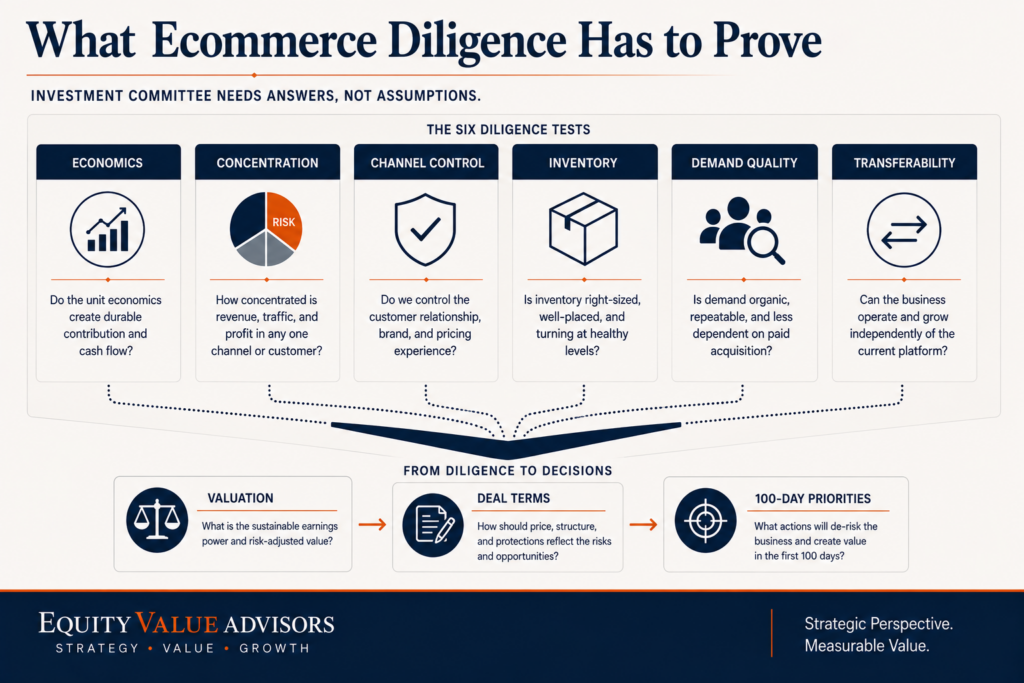
I would organize ecommerce diligence around six workstreams:
Economics, Concentration, Channel Control, Inventory, Demand Quality and Transferability.
Marketplace data deserves its own diligence questions
One issue buyers can underestimate is the difference between selling through a platform and controlling the information created by that customer activity.
Amazon sees shopper behavior across an enormous catalog. Individual sellers receive only part of that information.
When The New York Times discussed regulatory scrutiny of Amazon’s dual role as both marketplace operator and competitor, it cited my explanation of this informational advantage. Amazon can examine demand across its catalog and, as I described it:
For diligence, that leads to an important distinction:
What does the target know about its customers because it owns the information, and what does it know only because a marketplace currently chooses to provide access?
Those are not equivalent assets.
Economics
Test contribution by channel after:
- marketplace fees
- advertising
- fulfillment
- returns
- discounts
- agency costs
- incremental labor
- other variable channel expenses
Revenue growth without attractive incremental contribution can produce a very different investment outcome from what the headline growth rate suggests.
Concentration
Identify dependence on:
- Amazon or other marketplaces
- individual customers
- key SKUs
- paid media
- important employees
- agencies
- fulfillment partners
The relevant issue is not simply the concentration percentage. It is what happens economically if the dependency changes.
Channel control
Determine who controls:
- marketplace accounts
- advertising accounts
- Brand Registry
- customer and analytics data
- domains
- pricing decisions
- seller authorization
- distribution policy
- agency access
A buyer should know what actually transfers at close.
Inventory
Test:
- aged inventory
- excess inventory
- stranded marketplace inventory
- inventory turns
- returns
- forecast accuracy
- working-capital requirements
- SKU-level profitability
Inventory often contains ecommerce risk that the P&L has not yet revealed.
Demand quality
Separate demand the company creates from demand it effectively rents.
Understand organic marketplace position, paid-media dependence, repeat behavior, promotional sensitivity and the economics of incremental customer acquisition.
Transferability
Ask what happens if the founder, ecommerce leader, agency or marketplace representative disappears the day after closing.
Critical processes, access credentials, decisions and institutional knowledge should reside in the company rather than solely in individuals.
What diligence should ultimately prove
A diligence-ready ecommerce business should allow a buyer to conclude:
- the economics are real
- concentration is understood
- channels are controlled
- inventory is healthy
- demand is durable
- critical assets and knowledge will transfer
That is ultimately what turns ecommerce diligence from a revenue-validation exercise into an enterprise-value workstream.
The goal
Good ecommerce diligence does not try to eliminate uncertainty. It identifies the dependencies that deserve to be priced, fixed or deliberately accepted.
I work with PE sponsors, CEOs and boards where ecommerce, marketplaces or channel complexity can materially affect enterprise value. If that is a capability gap on your board, I am always interested in comparing notes.
James Thomson – former Amazon executive, four successful exits, board member/investor, and author of two books on marketplace governance and brand strategy.
Go deeper
The Agentic Commerce Brief
What changed in agentic commerce, and what it means for brands.
A concise weekly brief for brand executives navigating the shift from human-led shopping to agent-mediated commerce. Follow the developments that matter, the implications for brand control and governance, and the questions senior teams should be asking now.
Read The Agentic Commerce Brief on SubstackIf the signup form does not load, subscribe directly on Substack.