Board Member for PE-Backed Consumer, Ecommerce and Marketplace Companies
An ecommerce board member becomes particularly valuable to a PE-backed company when digital channels materially affect the investment thesis, margins, working capital, marketplace concentration or exit readiness. The role is not to operate ecommerce. It is to help the board test assumptions, identify dependencies, challenge capital-allocation decisions and recognize when seemingly tactical ecommerce issues have become material enterprise-level risks.
The board problem changes after private equity invests
PE-backed companies operate under a different clock. The strategic plan has a defined investment horizon. Growth must translate into earnings quality and enterprise value. Management has more resources, but it also has more explicit expectations. In that environment, the board needs directors who can help distinguish activity from progress.
For consumer and ecommerce companies, the complication is that digital growth can look stronger in a revenue report than it does in the economics. Marketplace fees rise. Advertising absorbs incremental gross profit. Inventory becomes less productive. Unauthorized sellers undermine channel strategy. A business can therefore grow its top line while weakening the quality of revenue a future buyer will diligence.
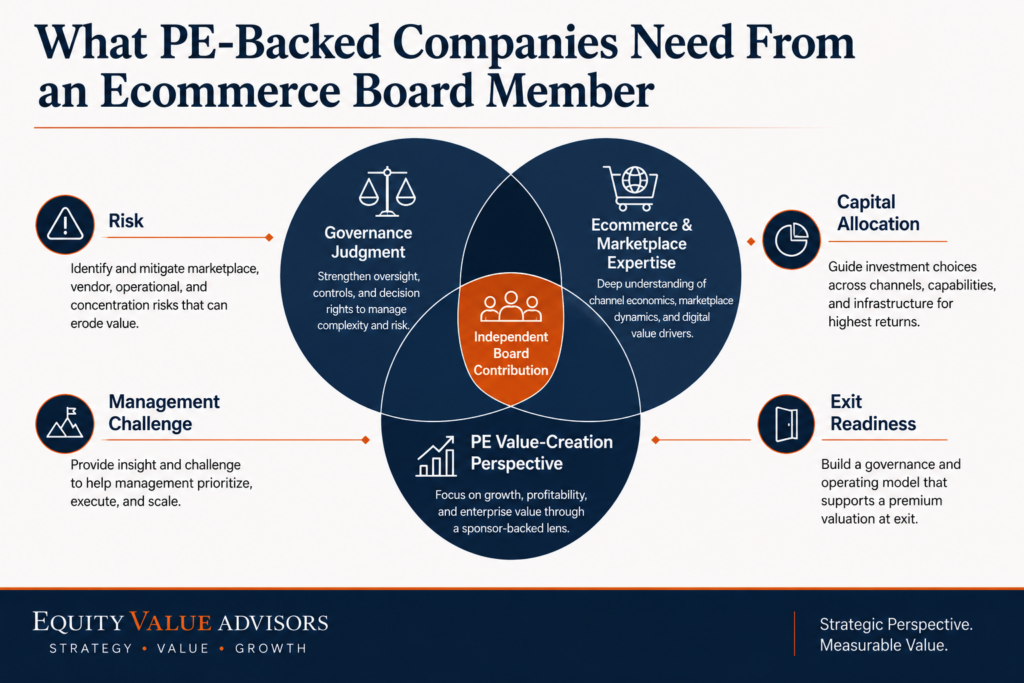
What I believe an independent director should contribute
An independent director should improve the quality of decisions. That means understanding the investment thesis, knowing which assumptions deserve regular testing and creating enough distance from management to ask difficult questions without becoming adversarial.
For ecommerce-heavy businesses, I focus on whether the board can see the economics by channel, whether incentives are aligned with contribution rather than vanity growth, whether Amazon or another platform has become a concentration risk, and whether the company is building operating discipline that a future buyer will trust.
Five situations where marketplace experience belongs in the boardroom
- When Amazon, Walmart or another marketplace represents a material portion of revenue.
- When the company has meaningful channel conflict among wholesale, DTC and marketplaces.
- When the investment thesis depends on ecommerce expansion or margin improvement.
- When marketplace complexity is likely to become a diligence issue at exit.
- When management is strong operationally but the board lacks someone who has seen marketplace-scale problems before.
What PE sponsors should expect from me
I do not approach a board seat as an open-ended consulting assignment. The board role comes first. I expect management to own execution. My contribution is to help the board establish the right questions, interpret the operating evidence and recognize when a seemingly tactical issue has become strategically material.
That usually means spending time on the quality of growth, channel-level contribution, customer and platform concentration, inventory discipline, governance of marketplace partners, organizational accountability and exit readiness.
What management should expect
Management should expect direct questions and no theatre. I am interested in whether the team has a coherent view of the business, not whether every slide is polished. When I disagree, I explain why. When management is right, I do not create work to prove I am involved.
The best board relationships are built on trust that challenge is intended to improve the enterprise, not to score points.
What this unlocks
A board with the right marketplace and ecommerce experience can move beyond episodic problem solving. It can establish a governance system that makes channel economics, operating risk and exit readiness visible before they become expensive.
When ecommerce expertise changes board decision quality
- When Marketplace Expertise Belongs on the Board
- Board Member, Operating Partner or Advisor?
- The Ecommerce Board Pack I Would Want to See
- Who Owns the Ecommerce Decision?
I work with PE sponsors, CEOs and boards where ecommerce, marketplaces or channel complexity can materially affect enterprise value. If that is a capability gap on your board, I am always interested in comparing notes.
James Thomson – former Amazon executive, four successful exits, board member/investor, and author of two books on marketplace governance and brand strategy.
The Agentic Commerce Brief
What changed in agentic commerce, and what it means for brands.
A concise weekly brief for brand executives navigating the shift from human-led shopping to agent-mediated commerce. Follow the developments that matter, the implications for brand control and governance, and the questions senior teams should be asking now.
Read The Agentic Commerce Brief on SubstackIf the signup form does not load, subscribe directly on Substack.