What PE-Backed Companies Should Look for in an Independent Board Member
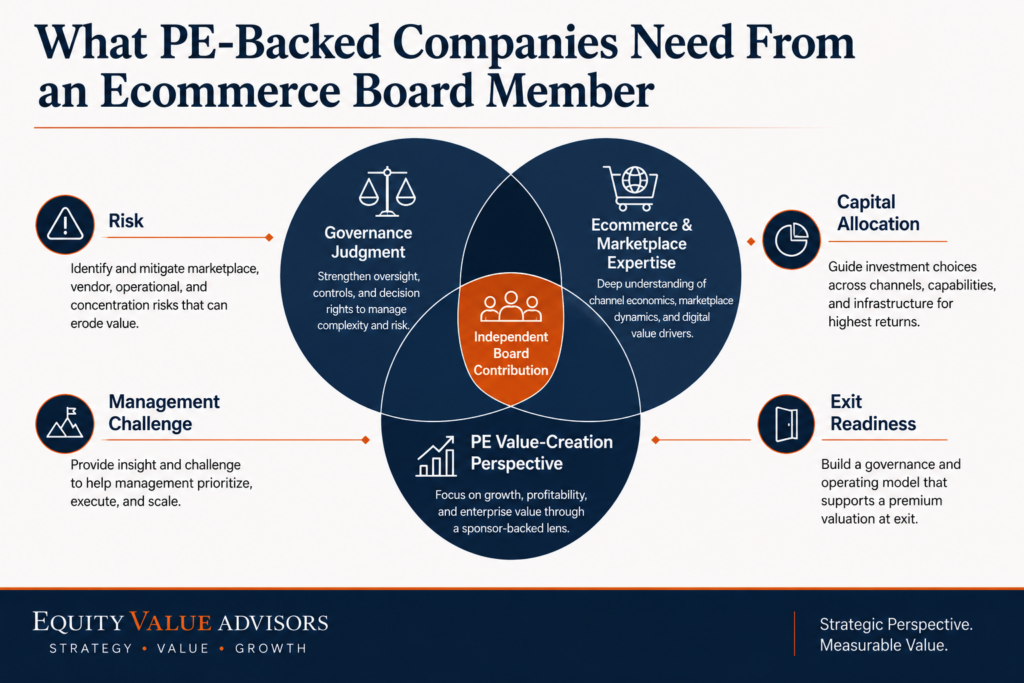
An ecommerce board member becomes particularly valuable to a PE-backed company when digital channels materially affect the investment thesis, margins, working capital, marketplace concentration or exit readiness. The role is not to operate ecommerce. It is to help the board test assumptions, identify dependencies, challenge capital-allocation decisions and recognize when seemingly tactical ecommerce issues have become material enterprise-level risks.
Start with the investment thesis
The wrong way to choose an independent director is to begin with a list of impressive resumes. Start with the investment thesis. What must the company accomplish before exit? Which assumptions are most likely to fail? Which capabilities are thin inside management and the existing board?
A director should be selected against those needs. If ecommerce is expected to be a major growth engine, a board with no meaningful ecommerce or marketplace experience has a predictable blind spot.
Domain experience is valuable only if it improves judgment
Deep subject experience can be useful, but boards do not need another functional executive. They need someone who can translate domain knowledge into governance questions. Knowing Amazon Seller Central is not a board skill. Understanding how Amazon concentration, channel conflict, contribution margin and inventory risk affect the investment thesis is.
Look for operating scars, not only operating success
Directors are most useful when they recognize failure patterns early. Someone who has scaled a company, made hiring mistakes, lived through margin compression, managed a transaction and seen diligence from both sides has a different reference set from someone whose career has been primarily observational.
The question is not whether a candidate has an immaculate history. It is whether the person learned enough from operating complexity to identify problems sooner the next time.
Test whether the candidate understands the boundary
One of the most important characteristics in an independent director is knowing when not to operate. A director who constantly reaches into management creates confusion about accountability. A passive director contributes little. The useful middle is informed oversight: enough knowledge to ask the right questions, enough discipline to leave execution with management.
Evaluate chemistry under disagreement
Board interviews are often too cordial. Sponsors should test how a candidate handles disagreement. Ask the person to challenge an element of the investment thesis. Ask for an example of a management decision they would support even if they personally preferred another path. The goal is to understand whether the candidate can disagree without making the relationship dysfunctional.
A simple selection test
Before adding an independent director, I would ask four questions: Does this person fill a capability gap that matters to the investment thesis? Will the CEO seek out this person’s judgment between meetings? Can this person challenge management without trying to replace management? Will this person make the board better when the company is under pressure?
If the answer to those questions is yes, the biography becomes secondary.
I work with PE sponsors, CEOs and boards where ecommerce, marketplaces or channel complexity can materially affect enterprise value. If that is a capability gap on your board, I am always interested in comparing notes.
James Thomson – former Amazon executive, four successful exits, board member/investor, and author of two books on marketplace governance and brand strategy.
The Agentic Commerce Brief
What changed in agentic commerce, and what it means for brands.
A concise weekly brief for brand executives navigating the shift from human-led shopping to agent-mediated commerce. Follow the developments that matter, the implications for brand control and governance, and the questions senior teams should be asking now.
Read The Agentic Commerce Brief on SubstackIf the signup form does not load, subscribe directly on Substack.