
A Board’s Guide to Ecommerce Governance
Ecommerce board governance is the system by which directors oversee the economics, risks, decision rights and dependencies created by digital channels without assuming management’s operating responsibilities. Good governance gives the board visibility into contribution, concentration, inventory, channel control and major platform risks while keeping execution clearly with management and ensuring material ecommerce decisions support the company’s investment thesis.
Ecommerce governance is not ecommerce management
It is not the board reviewing campaign tactics, ASIN details or weekly conversion rates. The distinction matters because boards can become overinvolved in visible digital activity while still missing the structural questions that matter.
The Board Ecommerce Health Check
I use six dimensions to frame the board conversation: economics, channel control, concentration, inventory, governance and exit readiness. A company does not need to be perfect on all six. The board does need to know where weakness is becoming material.
1. Economics
Can the board see contribution by major channel after marketplace fees, fulfillment, advertising, returns and channel-specific costs? Revenue and gross margin are insufficient if the economics that differ by channel are hidden in functional budgets.
2. Channel control
Does the company know who is selling its products, where inventory is leaking and whether distributors or unauthorized sellers are undermining pricing, assortment or advertising efficiency? Channel control is not purely a legal issue. It can change the economics of every legitimate seller.
3. Concentration
What percentage of revenue, profit or inventory exposure depends on Amazon, Walmart, Shopify, a small number of ASINs or a single logistics partner? Concentration is not automatically bad. Unmeasured concentration is.
4. Inventory
Is inventory treated as a strategic asset or simply an operating requirement? Excess stock, stockouts, aging inventory and channel imbalance can destroy cash conversion and force bad commercial decisions.
5. Governance
Who owns channel decisions? Are sales, ecommerce, finance, operations and marketing measured against compatible outcomes? If every function can improve its own KPI while total enterprise economics deteriorate, governance is weak.
6. Exit readiness
Could management explain the company’s ecommerce economics, channel risks and operating controls clearly to a sophisticated buyer tomorrow? If not, the company is accumulating diligence debt.
What belongs in the boardroom
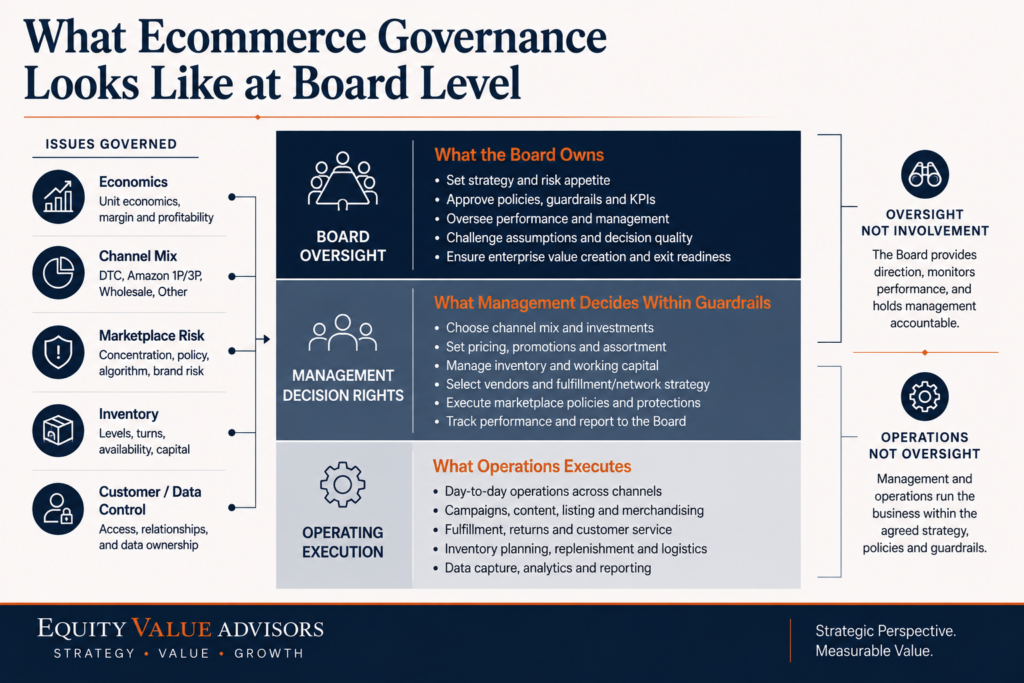
The board should focus on changes in the six dimensions, material exceptions and decisions that affect the investment thesis. The operating team should own the detailed actions. This creates a governance cadence that is useful without being intrusive.
| Board | Management |
|---|---|
| Sets oversight expectations | Executes |
| Reviews economics | Operates channels |
| Challenges assumptions | Chooses tactics |
| Monitors concentration | Manages accounts |
| Reviews capital allocation | Deploys capital |
The practical test
If ecommerce is material to enterprise value but the board cannot answer whether digital growth is economically attractive, controlled, diversified, inventory-efficient and diligence-ready, ecommerce governance needs work.
Related Questions
I work with PE sponsors, CEOs and boards where ecommerce, marketplaces or channel complexity can materially affect enterprise value. If that is a capability gap on your board, I am always interested in comparing notes.
James Thomson – former Amazon executive, two companies co-founded and sold, and two more advised through exit, board member/investor, and author of two books on marketplace governance and brand strategy.
Agentic Commerce Governance
As AI shopping agents become material, boards should focus on ownership, economics, customer-data implications and platform dependency rather than technical implementation. See Agentic Commerce Governance.
The EVA Board Commerce Health Check
Seven questions that expose where commerce risk is becoming material. No company needs to be strong on every dimension. The board does need to know where weakness is accumulating while management still has options.
- Economics. Is growth producing attractive contribution after channel-specific costs?
- Channel control. Does management know who sells the product, how inventory moves and where leakage begins?
- Concentration. Where is the business becoming dependent on a marketplace, retailer, platform or source of demand?
- Inventory. Is inventory supporting growth efficiently, or consuming cash and creating commercial pressure?
- Governance. Are decision rights and incentives aligned across ecommerce, sales, finance, marketing and operations?
- Agentic readiness. Can AI systems accurately understand the products, and has management decided what the brand should retain?
- Exit readiness. Could management explain its commerce economics, controls and dependencies to a sophisticated buyer tomorrow?
When should ecommerce become a board-level issue?
Ecommerce belongs in the boardroom when it can materially change the investment thesis, enterprise value, or risk profile. That usually occurs when digital channels drive a meaningful share of revenue or contribution, require substantial inventory or advertising capital, create platform concentration, or produce channel conflict. The board should not manage ecommerce operations. It should ensure management is measuring the economics correctly, governing the major dependencies, and addressing risks early enough to preserve options.
Why this matters
Once ecommerce can move valuation, cash generation or exit readiness, treating it as a functional issue creates a governance blind spot. Tactical marketplace problems can become enterprise problems quickly.
What the board should examine
- Revenue and contribution by channel
- Platform and customer concentration
- Inventory and working-capital exposure
- Paid-media dependency
- Channel-control and marketplace risks
- Whether ecommerce assumptions are explicit in the value-creation plan
What good looks like
The board receives a small set of decision-useful ecommerce metrics, understands the major dependencies, and knows which changes would require management action or a strategic decision.
How should a board assess ecommerce governance maturity?
Ecommerce governance is mature when decision rights, metrics, controls and escalation rules are explicit rather than dependent on personalities. Management can explain who owns channel economics, how platform risks are monitored, how inventory and distribution decisions interact, and which issues reach the board. Mature governance does not mean more meetings or bureaucracy. It means the company makes cross-functional decisions consistently, surfaces material exceptions early and can show evidence that the operating model works.
Key points
- Maturity is about explicit decisions and evidence, not the number of meetings.
- Personality-dependent governance fails when a key person leaves or a platform changes.
- The board should test maturity with specific scenarios, not presentations.
- Immature governance is common and fixable; hidden immaturity is the real risk.
What does each stage look like?
- Ad hoc. Decisions depend on whoever is available. Metrics are revenue and units. The board hears about problems after they have hit results.
- Defined. Owners are named for channel economics, pricing and distribution. Contribution by channel exists but is assembled manually.
- Managed. Decision rights, escalation thresholds and controls are documented and used. Leading indicators reach management before results move.
- Board-ready. The board sees a consistent pack, understands accepted risks and can trace any material decision to an owner and a rationale.
Which questions reveal the real stage?
- Who can change marketplace pricing, and who must approve an exception?
- How would we know within a week if Amazon advertising costs jumped 20%?
- What happens if the person who manages our marketplace accounts leaves tomorrow?
- Which ecommerce risks has management accepted deliberately, and which have nobody's name on them?
Answers that rely on a specific person's judgment, or on reports that need days to assemble, indicate an earlier stage than the presentation suggests.
Why does maturity affect enterprise value?
Buyers discount businesses whose ecommerce performance depends on undocumented knowledge, informal agency relationships or individuals. Mature governance makes the channel transferable, which supports valuation at exit. It also lowers the chance of a surprise during the hold period. See How should a buyer assess key-person and agency dependence in ecommerce?.
How should the board raise maturity without micromanaging?
Ask for the outputs of good governance rather than prescribing the process: a decision-rights map, a contribution view by channel, an escalation list and an annual platform-risk review. Let management design how those outputs are produced. Revisit the maturity assessment once a year.
What good looks like
Management can produce, within a day, a clear view of who decides what, how each channel contributes after all costs and which risks are being watched. The board sees the same metrics every quarter and is rarely surprised by an ecommerce event.
Frequently asked follow-up questions
How often should the board assess governance maturity?
Once a year is usually enough, with an extra review after a major change such as a new platform, a leadership change or an acquisition.
Who should run the assessment?
Management can self-assess against a clear framework. An independent review adds value before a transaction or when the board doubts the self-assessment.
Does a small ecommerce business need formal governance?
It needs proportionate governance. A small channel needs clear owners and a few reliable metrics, not a committee structure.
Who should own ecommerce decisions in a PE-backed company?
The executive who owns ecommerce economics should have clear authority over the decisions required to deliver them, while cross-functional policies remain explicit. Ecommerce often spans sales, marketing, operations, finance and supply chain, so unclear ownership leads to slow decisions and blame. In a PE-backed company, where the value-creation plan depends on speed, the board should confirm that decision rights match accountability and that conflicts between channels follow agreed rules rather than negotiation.
Key points
- Accountability without authority produces excuses; authority without accountability produces risk.
- Ecommerce decisions cut across functions, so the rules must be written down.
- Channel conflict should be resolved by policy, not by whoever argues hardest.
- The board should test decision rights, not choose the owner.
Which decisions need a clear owner?
- Channel pricing and promotional calendars
- Assortment by channel, including marketplace-exclusive products
- Advertising budgets and retail media spend
- Inventory allocation between channels and fulfillment networks
- Distribution policy and authorized seller decisions
- Selection of agencies, platforms and technology
What goes wrong without clear ownership?
Pricing decisions get escalated to the CEO. Retail sales teams block marketplace initiatives to protect their accounts. Inventory gets allocated by whoever asks first. Advertising budgets grow without anyone owning the return. Each problem looks small; together they slow the value-creation plan and confuse the board about what is working.
How should cross-functional conflicts be handled?
Write the rules once: how channel pricing is set, which products go to which channels, how inventory is allocated when supply is short. Name a forum for exceptions and a final decision-maker. Report material exceptions to the board.
What should the board look for?
- A decision-rights map that management actually uses
- One executive accountable for ecommerce contribution
- Written channel policies and a record of exceptions
- Metrics that the ecommerce, sales and finance teams all accept
See How should a board assess ecommerce governance maturity?.
What good looks like
Anyone in the company can say who decides channel pricing, assortment, advertising and inventory. Conflicts follow written rules. The board sees one accountable executive and a set of metrics that every function accepts.
Frequently asked follow-up questions
Should the head of ecommerce report to the CEO?
Often, when ecommerce is central to the plan. What matters more is that the role has authority over the decisions that drive ecommerce results.
Can ecommerce sit inside sales or marketing?
It can, if decision rights are explicit and the channel's economics are visible. Problems arise when ecommerce becomes subordinate to another channel's priorities.
How often should decision rights be revisited?
After any reorganization, acquisition or major channel change, and at least once a year.
What ecommerce issues belong in a PE 100-day plan?
The first 100 days should validate the ecommerce assumptions that matter most to the investment thesis and assign ownership for any gaps found in diligence. Priorities typically include confirming channel contribution, account and credential control, inventory quality, marketplace concentration, advertising economics, distribution leakage and reporting definitions. The goal is not to redesign every operating process immediately. It is to establish reliable baselines, close high-risk control gaps and make sure management and the board are using the same measures from the start.
Why this matters
Early ownership is when sponsors have the greatest ability to convert diligence findings into operating discipline before legacy habits become embedded in the value-creation plan.
What the board should examine
- Diligence findings and owners
- Baseline board scorecard
- Marketplace access and permissions
- Inventory and working-capital risks
- Paid-media economics
- Decision rights and reporting cadence
What good looks like
By day 100, material risks have accountable owners, the board has a trusted ecommerce baseline, and management has a prioritized plan tied directly to value creation.
The Agentic Commerce Brief
What changed in agentic commerce, and what it means for brands.
A concise weekly brief for brand executives navigating the shift from human-led shopping to agent-mediated commerce. Follow the developments that matter, the implications for brand control and governance, and the questions senior teams should be asking now.
Read The Agentic Commerce Brief on SubstackIf the signup form does not load, subscribe directly on Substack.