Marketplace Governance: What Boards Need to Know About Amazon and Other Marketplaces
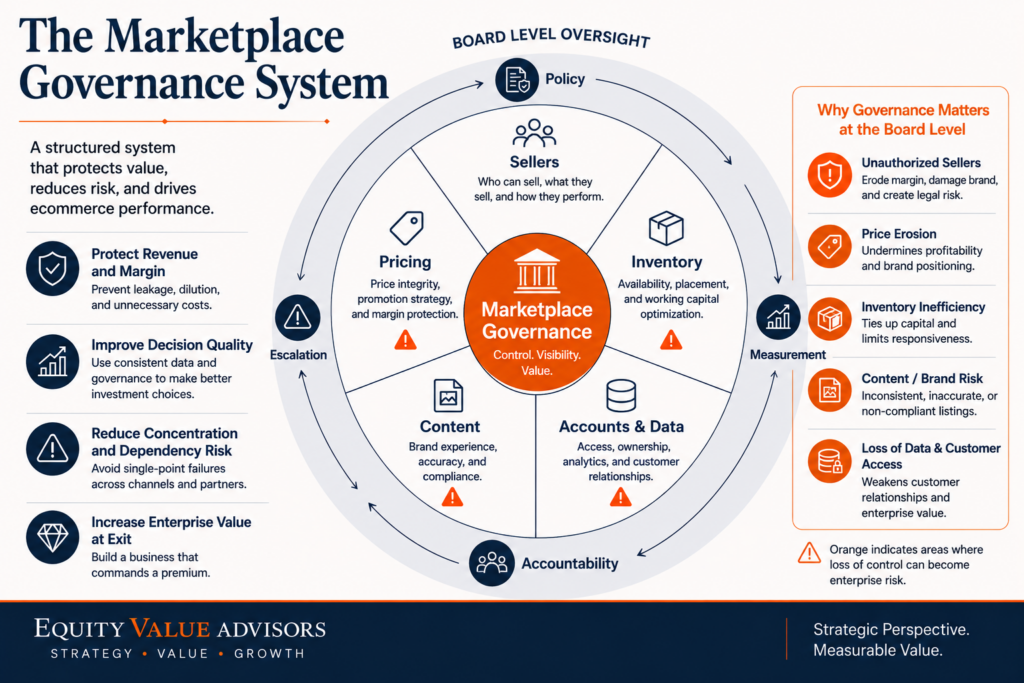
Marketplace governance is the system a company uses to establish ownership, policies, metrics and escalation rules across marketplace pricing, sellers, inventory, content, accounts and data. As marketplaces become material, these issues stop being isolated ecommerce tasks. Effective governance connects them so management can identify economic tradeoffs, control important assets and give the board visibility into marketplace risks that could affect enterprise value.
Marketplaces are systems, not sales accounts
When a marketplace becomes material, the board should stop treating it as a sales account and start treating it as part of the company’s operating system. Amazon can affect pricing, inventory placement, advertising, distributor behavior, customer acquisition and wholesale relationships at the same time.
That interdependence is why marketplace problems frequently persist despite capable people working hard inside individual functions.
Marketplace control includes information control
One frequently overlooked part of marketplace governance is who possesses the information required to make decisions.
Amazon does not simply operate a storefront. It observes enormous amounts of shopper behavior across categories and products. The information available to Amazon and the information available to an individual brand are not necessarily the same.
I described that asymmetry to The New York Times when it examined Amazon’s private-label strategy:
“Amazon has access to data that nobody else has.”
I used the example of a consumer considering a product but deciding not to purchase it. Amazon can observe behavioral signals across its marketplace that an individual manufacturer may never see.
For a board, this is not an argument against Amazon.
It is a reason to understand which parts of the customer relationship, demand signal and decision-making data the company actually controls.
The Marketplace Governance Maturity Model
I think about marketplace governance in four stages: reactive, managed, governed and diligence-ready.
Reactive
Problems are handled individually. A Buy Box issue goes to ecommerce. A pricing issue goes to sales. Excess inventory goes to operations. No one owns the combined economics.
Managed
The company has clear functional owners, reporting and standard operating procedures. This is better, but functions can still optimize locally.
Governed
Channel decisions use shared economic objectives. The company understands seller authorization, distribution, pricing, marketplace assortment, inventory and advertising as one connected system.
Diligence-ready
The company can explain and document the system to a sophisticated buyer. Rights are clear. Data is accessible. Account ownership is controlled. Channel economics reconcile to financial reporting. Key-person dependencies are limited.
Questions for the board
- Who owns marketplace economics across functions?
- Does the company know all material sellers of its products?
- Are distributor incentives consistent with marketplace objectives?
- Can management quantify the economic effect of unauthorized sellers or pricing leakage?
- How dependent is the investment thesis on marketplace growth?
- Would a buyer view the company’s marketplace operations as a controlled asset or an operating risk?
The governance objective
The objective is not to eliminate every marketplace problem. That is unrealistic. The objective is to make sure decisions are coherent, risks are visible and management is not rewarded for solving one channel’s problem by creating another channel’s problem.
I work with PE sponsors, CEOs and boards where ecommerce, marketplaces or channel complexity can materially affect enterprise value. If that is a capability gap on your board, I am always interested in comparing notes.
James Thomson – former Amazon executive, four successful exits, board member/investor, and author of two books on marketplace governance and brand strategy.
Agentic Commerce and the Next Commerce Intermediary
AI shopping agents extend many of the same governance questions marketplaces created: who controls discovery, product representation, customer access and channel economics. See Agentic Commerce for Brand Executives and Agentic Commerce Governance.
The Agentic Commerce Brief
What changed in agentic commerce, and what it means for brands.
A concise weekly brief for brand executives navigating the shift from human-led shopping to agent-mediated commerce. Follow the developments that matter, the implications for brand control and governance, and the questions senior teams should be asking now.
Read The Agentic Commerce Brief on SubstackIf the signup form does not load, subscribe directly on Substack.