Channel Control and Unauthorized Sellers: A Board-Level Governance Issue
Ecommerce channel control is the ability to understand and govern who sells the brand’s products, where inventory flows, who controls marketplace accounts and how pricing, customer access and distribution decisions interact. Weak channel control can create unauthorized sellers, pricing conflict, wasted advertising and retailer friction. Boards should focus on whether these issues are isolated incidents or symptoms of a broader distribution and governance problem.
Unauthorized sellers are rarely only an ecommerce problem
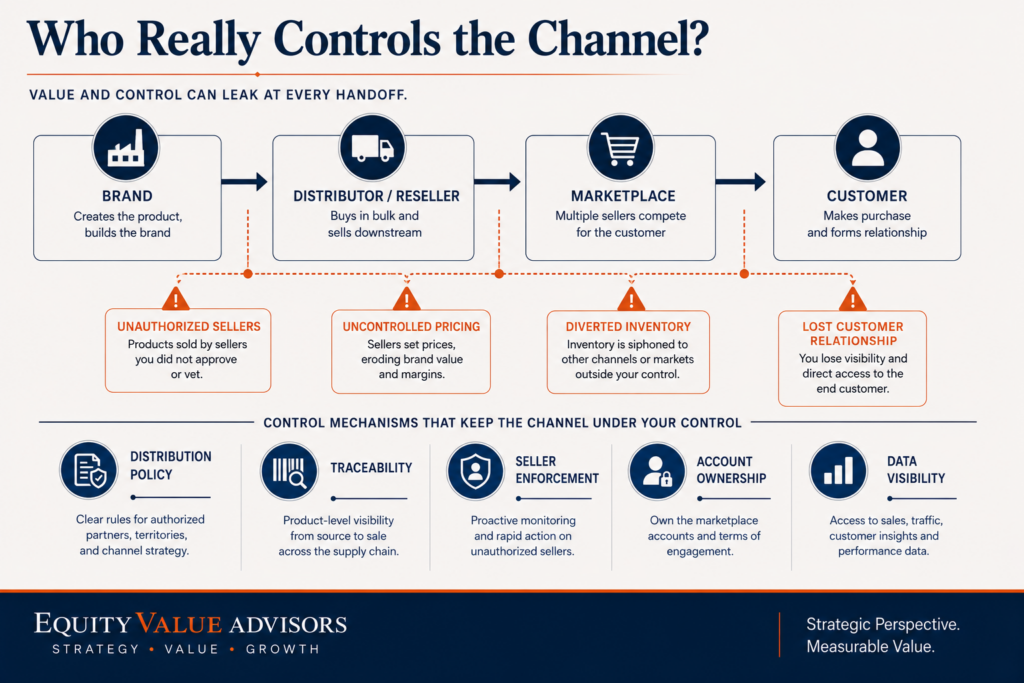
When an unauthorized seller appears on Amazon, the visible symptom is a marketplace listing. The underlying cause may sit somewhere else: distributor incentives, excess inventory, poor authorization controls, liquidation, international diversion or inconsistent commercial policies.
That is why repeated seller takedowns often fail to solve the economic problem.
“The root cause of the Amazon problem is a brand’s distribution problem.”
I made that observation in a 2017 Digiday interview, and the underlying lesson remains useful. Repeated unauthorized selling generally warrants an upstream review of distribution, inventory and incentives rather than an endless series of marketplace takedowns.
Channel control is ultimately about decision rights
The issue becomes more consequential when another party can materially influence the economics of your channel. Marketplace platforms determine important elements of customer visibility and commerce on their sites. Brands may formally control their own prices while still facing powerful economic consequences from platform decisions.
That distinction was at the center of a 2021 New York Times article examining Amazon’s pricing practices.
The article described situations in which merchants could lose prominent purchase functionality when Amazon identified lower prices elsewhere. Discussing what such uncertainty meant for marketplace sellers, I told the Times:
“This is a living-in-fear, all-the-time, type of event for any seller on Amazon.”
For a board, the important issue is not the rhetoric of any particular seller dispute. It is the underlying governance question:
How much of our economics depends upon rules and decisions that somebody else controls?
How channel leakage affects enterprise value
Unauthorized supply can pressure pricing, win the Buy Box, reduce the return on legitimate advertising, create retailer conflict and make the brand’s distribution model harder to explain. The effect may appear across sales, marketing and finance rather than in one clean line item.
If the impact is material, the board should understand it.
The board questions
- Does management know where unauthorized sellers obtain inventory?
- Which distributors or resellers have economic incentives that conflict with the brand’s marketplace strategy?
- Can the company quantify the effect on price, contribution and advertising efficiency?
- Are channel policies enforceable and commercially realistic?
- Is excess inventory creating leakage?
- Who owns channel governance across sales, ecommerce, legal and finance?
Takedowns are not a strategy
Enforcement can be useful, but channel control is primarily an incentive and distribution design problem. If authorized partners can profit by moving inventory into unintended channels, unauthorized supply will tend to reappear.
The durable answer is to align commercial terms, inventory flow, authorization and enforcement.
When it becomes a board issue
The board does not need a list of every unauthorized seller. It does need visibility when channel leakage affects pricing architecture, major retailer relationships, contribution economics or the investment thesis.
At that point the question is no longer, ‘How do we remove this seller?’ It is, ‘Why does our system keep creating this outcome?’
I work with PE sponsors, CEOs and boards where ecommerce, marketplaces or channel complexity can materially affect enterprise value. If that is a capability gap on your board, I am always interested in comparing notes.
James Thomson – former Amazon executive, four successful exits, board member/investor, and author of two books on marketplace governance and brand strategy.
Channel Control in Agentic Commerce
AI agents may automatically choose among authorized and unauthorized offers, making upstream distribution control even more important. See Brand Control in the Age of Agentic Commerce and The Agentic Commerce Control Model.
Go deeper
The Agentic Commerce Brief
What changed in agentic commerce, and what it means for brands.
A concise weekly brief for brand executives navigating the shift from human-led shopping to agent-mediated commerce. Follow the developments that matter, the implications for brand control and governance, and the questions senior teams should be asking now.
Read The Agentic Commerce Brief on SubstackIf the signup form does not load, subscribe directly on Substack.