Ecommerce Due Diligence for Private Equity Investors and Boards
Private equity ecommerce diligence should determine whether growth is economically attractive, controlled, durable and transferable. A buyer should test channel contribution, platform and customer concentration, inventory quality, paid-demand dependence, marketplace and account control, and reliance on key people or agencies. The objective is to understand what could alter valuation, require post-close intervention or prevent the ecommerce operating system from transferring cleanly.
Ecommerce diligence needs to test the system, not simply validate sales
A growing ecommerce business can look attractive in the financial statements while carrying risks that become visible only when someone examines how the revenue is actually produced.
The question for a buyer is therefore not simply:
“How fast is ecommerce growing?”
It is:
“How durable, controlled and transferable is the system producing that growth?”
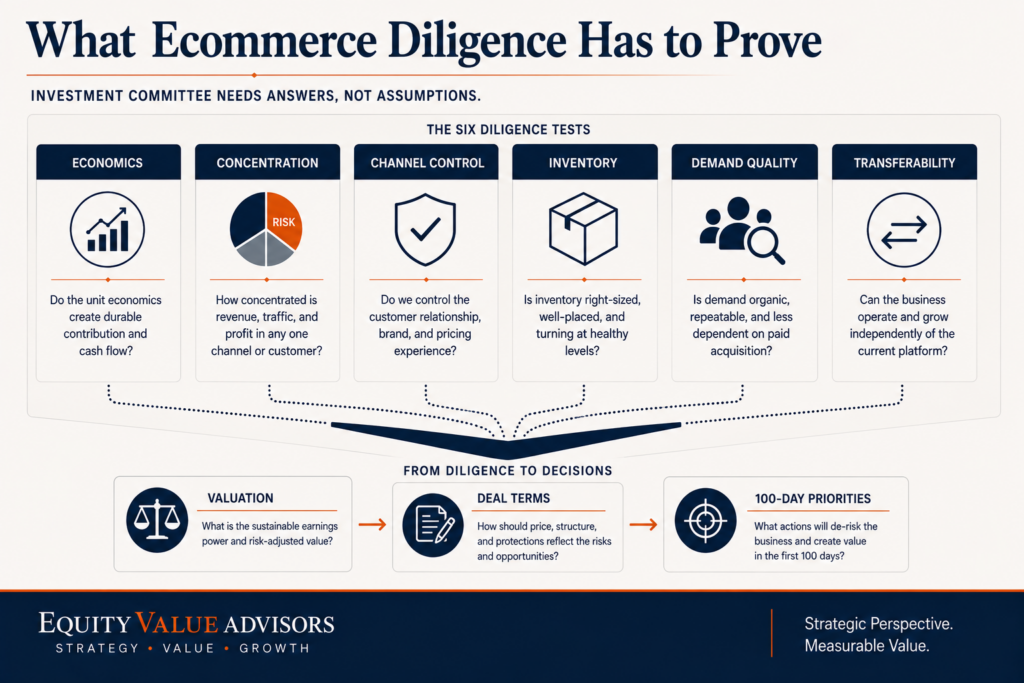
I would organize ecommerce diligence around six workstreams:
Economics, Concentration, Channel Control, Inventory, Demand Quality and Transferability.
Marketplace data deserves its own diligence questions
One issue buyers can underestimate is the difference between selling through a platform and controlling the information created by that customer activity.
Amazon sees shopper behavior across an enormous catalog. Individual sellers receive only part of that information.
When The New York Times discussed regulatory scrutiny of Amazon’s dual role as both marketplace operator and competitor, it cited my explanation of this informational advantage. Amazon can examine demand across its catalog and, as I described it:
For diligence, that leads to an important distinction:
What does the target know about its customers because it owns the information, and what does it know only because a marketplace currently chooses to provide access?
Those are not equivalent assets.
Economics
Test contribution by channel after:
- marketplace fees
- advertising
- fulfillment
- returns
- discounts
- agency costs
- incremental labor
- other variable channel expenses
Revenue growth without attractive incremental contribution can produce a very different investment outcome from what the headline growth rate suggests.
Concentration
Identify dependence on:
- Amazon or other marketplaces
- individual customers
- key SKUs
- paid media
- important employees
- agencies
- fulfillment partners
The relevant issue is not simply the concentration percentage. It is what happens economically if the dependency changes.
Channel control
Determine who controls:
- marketplace accounts
- advertising accounts
- Brand Registry
- customer and analytics data
- domains
- pricing decisions
- seller authorization
- distribution policy
- agency access
A buyer should know what actually transfers at close.
Inventory
Test:
- aged inventory
- excess inventory
- stranded marketplace inventory
- inventory turns
- returns
- forecast accuracy
- working-capital requirements
- SKU-level profitability
Inventory often contains ecommerce risk that the P&L has not yet revealed.
Demand quality
Separate demand the company creates from demand it effectively rents.
Understand organic marketplace position, paid-media dependence, repeat behavior, promotional sensitivity and the economics of incremental customer acquisition.
Transferability
Ask what happens if the founder, ecommerce leader, agency or marketplace representative disappears the day after closing.
Critical processes, access credentials, decisions and institutional knowledge should reside in the company rather than solely in individuals.
What diligence should ultimately prove
A diligence-ready ecommerce business should allow a buyer to conclude:
- the economics are real
- concentration is understood
- channels are controlled
- inventory is healthy
- demand is durable
- critical assets and knowledge will transfer
That is ultimately what turns ecommerce diligence from a revenue-validation exercise into an enterprise-value workstream.
The goal
Good ecommerce diligence does not try to eliminate uncertainty. It identifies the dependencies that deserve to be priced, fixed or deliberately accepted.
I work with PE sponsors, CEOs and boards where ecommerce, marketplaces or channel complexity can materially affect enterprise value. If that is a capability gap on your board, I am always interested in comparing notes.
James Thomson – former Amazon executive, two companies co-founded and sold, and two more advised through exit, board member/investor, and author of two books on marketplace governance and brand strategy.
How should a buyer assess key-person and agency dependence in ecommerce?
A buyer should assume key-person risk exists when one individual holds critical marketplace knowledge, credentials, agency relationships or exception-handling expertise that is not documented elsewhere. The same applies to agencies that run advertising, listings or account health on the company's behalf. The test is simple: if that person or agency left next month, would performance hold? If nobody can answer confidently, the risk is real and belongs in the valuation and the transition plan.
Key points
- Ecommerce capability often sits in a few people or an outside agency.
- Undocumented knowledge does not transfer at close.
- Agency dependence is acceptable when the company owns its accounts, data and know-how.
- The remedy is documentation, access control and transition planning, not avoidance.
Where does key-person risk usually hide?
- Account access. Seller Central, advertising and retailer portal credentials held by one person or the agency.
- Exception handling. Knowing how to resolve listing suppressions, account health warnings or fulfillment disputes.
- Platform relationships. Contacts at Amazon, Walmart or retailers who respond to one individual.
- Advertising logic. Bidding strategies and campaign structures that only the agency understands.
- Content and catalog. Product data maintained in spreadsheets on someone's laptop.
How should a buyer test it during diligence?
- Ask who holds administrator access to every marketplace and advertising account.
- Request the agency contract and check who owns the accounts, data and campaign history.
- Interview the people below the key person and see how much they can explain.
- Ask for the last three account health incidents and who resolved them.
Answers should come from documents and systems, not reassurance.
When is agency dependence acceptable?
Many strong brands use agencies. Dependence is acceptable when the company owns its accounts and data, understands the strategy the agency executes and could replace the agency without losing performance. It becomes a risk when the agency effectively is the capability and the company could not explain its own results.
How should the risk affect the deal?
Material dependence can justify retention arrangements for key individuals, transition services from the agency, a documentation workstream in the first 100 days or a valuation adjustment. The goal is to protect the earnings that justified the price. See What should private equity test in ecommerce diligence?.
What good looks like
The company owns every account and data set, documents its processes and has at least two people who can run critical marketplace operations. Agencies execute a strategy the company understands. A buyer can verify all of this in a day.
Frequently asked follow-up questions
Is a founder-led ecommerce operation always a key-person risk?
Not always, but often. The risk depends on whether the founder's knowledge has been captured in people, processes and systems.
Should a buyer insist on replacing the agency?
Rarely. A good agency is an asset. The buyer should insist on ownership of accounts and data, and on a clear transition clause.
How long does it take to reduce key-person risk?
Documentation and access fixes take weeks. Building internal depth takes months. Start in the first 100 days.
How can a buyer tell whether ecommerce growth is durable?
Durable ecommerce growth does not depend on one temporary source of demand, one marketplace, one promotion, or continuously rising advertising spend. Boards should look for stable or improving contribution, repeat demand, healthy inventory productivity, diversified acquisition sources and evidence that customers value the product independent of paid placement. Growth can still be concentrated and durable, but management should be able to explain why the economics persist and which assumptions would fail first if market conditions change.
Why this matters
Growth multiples depend on confidence that today’s performance can continue. Fragile growth often reveals itself first through deteriorating economics or rising dependency.
What the board should examine
- Organic versus paid demand
- Repeat purchase and retention where relevant
- Contribution on incremental revenue
- Platform and SKU concentration
- Inventory turns and service levels
- Growth after promotional activity normalizes
What good looks like
The company can identify the drivers of growth, measure their economics, and show that performance does not require progressively more capital or risk to sustain.
What ecommerce accounts and data must a buyer control at close?
A buyer needs control of the systems that actually produce ecommerce revenue. That includes marketplace and advertising accounts, administrator credentials, domains and analytics access, data rights, key contracts, agency relationships, operating documentation, seller authorizations and the knowledge required to run the channel. Legal ownership on paper is not enough if access resides with a founder, employee or outside agency. Diligence should confirm transferability before signing and the closing plan should specify who controls each critical asset on day one.
Why this matters
Revenue can be economically real yet operationally non-transferable. Missing credentials, informal relationships or unclear account ownership can create avoidable post-close risk.
What the board should examine
- Marketplace account ownership
- Advertising and analytics access
- Domains, data and intellectual property
- Agency and supplier contracts
- Authorization policies
- Documentation and key-person knowledge
What good looks like
Every critical ecommerce asset has a verified owner, a tested transfer path and a named post-close administrator. No material revenue stream depends on access the buyer cannot control.
What ecommerce questions should an investment committee ask before closing?
An investment committee should focus on the ecommerce assumptions capable of changing underwriting: how attractive channel contribution really is, how dependent growth is on marketplaces and paid media, how much working capital is required, whether inventory and channel control are healthy, and whether the operating system will transfer cleanly to a new owner. The committee does not need tactical marketplace detail. It needs evidence that forecast growth, margin expansion and exit assumptions remain credible after the major ecommerce dependencies are made explicit.
Why this matters
Ecommerce can materially change both upside and downside while remaining underexplored in conventional commercial and financial diligence.
What the board should examine
- Quality of channel contribution
- Platform and customer concentration
- Paid-demand dependency
- Inventory and cash needs
- Channel-control risks
- Key-person and transferability risk
- First 100-day implications
What good looks like
The investment case states the major ecommerce assumptions explicitly, diligence tests them with evidence, and the value-creation plan assigns actions to any material weaknesses identified before close.
Which ecommerce risks can change private equity valuation?
The ecommerce risks most likely to affect valuation are those that weaken earnings quality, increase required capital or make future performance less transferable. Examples include platform concentration, deteriorating channel contribution, excessive paid-media dependency, aging inventory, unauthorized-seller leakage, weak marketplace account controls, unreliable data and dependence on one employee or agency. None is automatically fatal. The valuation impact depends on materiality, evidence, remediation cost and whether the issue calls the broader growth thesis into question.
Why this matters
Buyers discount uncertainty. Risks become more expensive when management cannot quantify them, explain their cause or show that controls are already working.
What the board should examine
- Size of the economic exposure
- Trend and persistence of the issue
- Cash or capital required to remediate
- Impact on forecast confidence
- Whether the risk survives a change of ownership
What good looks like
Material ecommerce risks are measured before a transaction, assigned to accountable owners and supported by evidence showing either effective control or a credible remediation plan.
Go deeper
The Agentic Commerce Brief
What changed in agentic commerce, and what it means for brands.
A concise weekly brief for brand executives navigating the shift from human-led shopping to agent-mediated commerce. Follow the developments that matter, the implications for brand control and governance, and the questions senior teams should be asking now.
Read The Agentic Commerce Brief on SubstackIf the signup form does not load, subscribe directly on Substack.