
What should be in an ecommerce board pack?
Short answer: An ecommerce board pack should show whether digital growth is economically attractive, controlled, resilient, and aligned with the value-creation plan. It should compress operating complexity into a small set of trends, exceptions, and decisions.
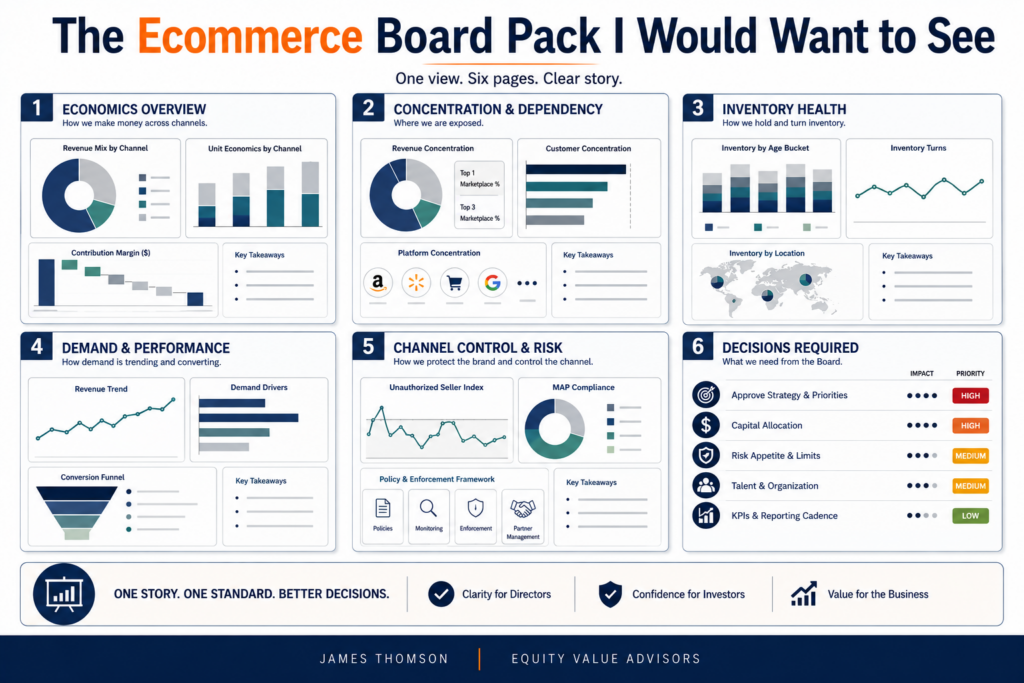
Page 1: economic performance
Show revenue and contribution by major channel versus plan and prior year, with a bridge explaining material changes. Include the major channel-specific costs management uses to define contribution.
Page 2: concentration and demand
Show platform/customer concentration, top-SKU or ASIN concentration, and paid-demand dependence. Highlight changes rather than static percentages.
Page 3: inventory and cash
Show aging, turns, stockout exceptions, channel/location imbalances, and working-capital implications. Connect inventory to the growth plan and downside case.
Page 4: channel control and operating risk
Summarize economically material unauthorized-seller issues, platform/account risks, critical partner dependencies, and remediation milestones. Avoid long issue logs.
Page 5: decisions
End with what management needs from the board: capital allocation, strategic choice, risk acceptance, or leadership accountability. Operating detail can sit in an appendix.
EVA perspective
The board pack should teach the organization what the board values. If it emphasizes revenue and activity, teams will optimize those. If it emphasizes contribution, concentration, cash, control, and decisions, the operating conversation changes.
Related James Thomson resources
James Thomson helps PE sponsors, CEOs and boards govern ecommerce, marketplaces and channel complexity as enterprise-value issues.