Board Member for PE-Backed Consumer, Ecommerce and Marketplace Companies
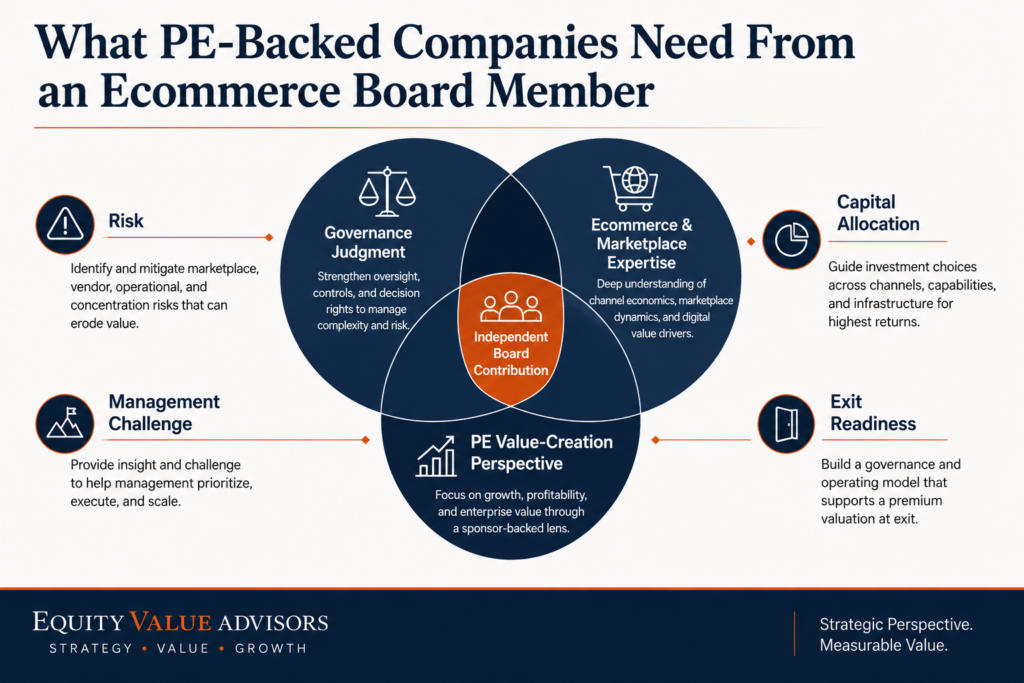
An ecommerce board member becomes particularly valuable to a PE-backed company when digital channels materially affect the investment thesis, margins, working capital, marketplace concentration or exit readiness. The role is not to operate ecommerce. It is to help the board test assumptions, identify dependencies, challenge capital-allocation decisions and recognize when seemingly tactical ecommerce issues have become material enterprise-level risks.
The board problem changes after private equity invests
PE-backed companies operate under a different clock. The strategic plan has a defined investment horizon. Growth must translate into earnings quality and enterprise value. Management has more resources, but it also has more explicit expectations. In that environment, the board needs directors who can help distinguish activity from progress.
For consumer and ecommerce companies, the complication is that digital growth can look stronger in a revenue report than it does in the economics. Marketplace fees rise. Advertising absorbs incremental gross profit. Inventory becomes less productive. Unauthorized sellers undermine channel strategy. A business can therefore grow its top line while weakening the quality of revenue a future buyer will diligence.
James Thomson's current board and advisory roles
- Plugable Technologies: Independent Board Member
- DaVinci Micro Fulfillment: Board Member and Investor; Audit Committee
- Mamenta: Board Member and Investor
- Mavi: Board Member and Investor
- PathLLM: Board Advisor
- A-Ventures Global: Advisory Partner
What I believe an independent director should contribute
An independent director should improve the quality of decisions. That means understanding the investment thesis, knowing which assumptions deserve regular testing and creating enough distance from management to ask difficult questions without becoming adversarial.
For ecommerce-heavy businesses, I focus on whether the board can see the economics by channel, whether incentives are aligned with contribution rather than vanity growth, whether Amazon or another platform has become a concentration risk, and whether the company is building operating discipline that a future buyer will trust.
Five situations where marketplace experience belongs in the boardroom
- When Amazon, Walmart or another marketplace represents a material portion of revenue.
- When the company has meaningful channel conflict among wholesale, DTC and marketplaces.
- When the investment thesis depends on ecommerce expansion or margin improvement.
- When marketplace complexity is likely to become a diligence issue at exit.
- When management is strong operationally but the board lacks someone who has seen marketplace-scale problems before.
What PE sponsors should expect from me
I do not approach a board seat as an open-ended consulting assignment. The board role comes first. I expect management to own execution. My contribution is to help the board establish the right questions, interpret the operating evidence and recognize when a seemingly tactical issue has become strategically material.
That usually means spending time on the quality of growth, channel-level contribution, customer and platform concentration, inventory discipline, governance of marketplace partners, organizational accountability and exit readiness.
What management should expect
Management should expect direct questions and no theatre. I am interested in whether the team has a coherent view of the business, not whether every slide is polished. When I disagree, I explain why. When management is right, I do not create work to prove I am involved.
The best board relationships are built on trust that challenge is intended to improve the enterprise, not to score points.
What this unlocks
A board with the right marketplace and ecommerce experience can move beyond episodic problem solving. It can establish a governance system that makes channel economics, operating risk and exit readiness visible before they become expensive.
When ecommerce expertise changes board decision quality
- When Marketplace Expertise Belongs on the Board
- Board Member, Operating Partner or Advisor?
- The Ecommerce Board Pack I Would Want to See
- Who Owns the Ecommerce Decision?
I work with PE sponsors, CEOs and boards where ecommerce, marketplaces or channel complexity can materially affect enterprise value. If that is a capability gap on your board, I am always interested in comparing notes.
James Thomson – former Amazon executive, two companies co-founded and sold, and two more advised through exit, board member/investor, and author of two books on marketplace governance and brand strategy.
Board member, operating partner or advisor: which does a PE-backed company need?
Start with the decision rights. A board member fits an ongoing governance need tied to the investment thesis and carries fiduciary accountability. An operating partner fits when the sponsor wants hands-on support across value-creation priorities. An advisor fits a specialized, project-based or time-limited need. If the work requires weekly decisions, people management and direct operating accountability, the company needs an executive. The common mistake is using a governance role to cover an unresolved management gap.
Key points
- Choose the role by the decisions it must influence, not by the person's résumé.
- Directors oversee; operating partners help execute the value-creation plan; advisors solve defined problems.
- A governance role cannot fix a missing executive.
- The same expert can fit different roles at different stages of the investment.
Why does the choice matter?
The wrong role creates unclear accountability. A director drawn into operations weakens management and loses independence. An advisor expected to deliver results has no authority to make them happen. An operating partner with no defined mandate competes with the CEO for attention.
Each failure is expensive in a PE hold period, where time is the scarcest resource. Months spent untangling roles are months not spent on the value-creation plan.
How do the three roles differ?
- Board member. Holds fiduciary duties, votes on major decisions and oversees management over the life of the investment. Best when an issue recurs at board level and affects capital allocation, valuation or risk appetite.
- Operating partner. Works with management on specific value-creation levers, often across several portfolio companies. Best when the sponsor wants direct support on execution without adding an executive.
- Advisor. Provides expertise on a defined question for a defined period, such as a channel review, a diligence workstream or a technology decision. Best when the need is bounded and the company can absorb the answer itself.
- Executive. Owns results day to day. Needed when the work requires weekly decisions, a team and accountability for delivery.
Which questions settle the choice?
- Will this issue appear on the board agenda for most of the hold period?
- Does the work require authority over people or budgets?
- Is there a clear end point, such as a decision, a report or a launch?
- Does management already have the capability, and only need challenge?
If the answer to the first question is yes and the fourth is also yes, the company needs a director. If the work has a clear end point, it needs an advisor. If it requires authority, it needs an executive.
How does this apply to ecommerce and marketplaces?
Ecommerce questions often start as projects and become governance issues. A company might hire an advisor to review its Amazon strategy, then discover that marketplace concentration, advertising dependence and channel conflict will shape the investment case for years. At that point the need has moved from advice to oversight. See When does marketplace expertise belong on a company board?.
What good looks like
The company can say in one sentence what each role is responsible for and how success will be judged. Directors focus on oversight, operating partners on a named set of value-creation levers and advisors on defined deliverables. Nobody in a governance or advisory role is quietly running a function.
Frequently asked follow-up questions
Can one person move from advisor to director?
Yes, and it is common. An advisor who has learned the business can become an effective director once the need becomes recurring. The change should be explicit, with new responsibilities and a clear end to the advisory scope.
Should an operating partner sit on the board?
Sometimes. It works when the operating partner's mandate aligns with the board's oversight role. It creates confusion when the operating partner is also directing management on execution.
How long should an advisory engagement last?
As long as the defined question takes to answer. An engagement with no end point has usually become a role that should be structured differently.
The Agentic Commerce Brief
What changed in agentic commerce, and what it means for brands.
A concise weekly brief for brand executives navigating the shift from human-led shopping to agent-mediated commerce. Follow the developments that matter, the implications for brand control and governance, and the questions senior teams should be asking now.
Read The Agentic Commerce Brief on SubstackIf the signup form does not load, subscribe directly on Substack.