
Controlling Your Brand in the Age of Amazon
By Whitney Gibson and James Thomson
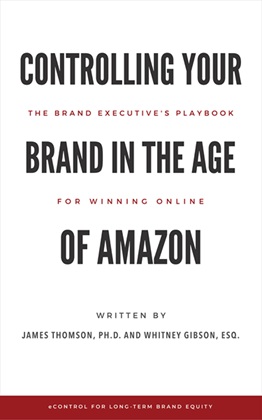
Controlling Your Brand in the Age of Amazon was written around a problem we repeatedly encountered with consumer brands:
Companies frequently believed they had an Amazon problem when the underlying problem was somewhere else in the business.
Unauthorized sellers were often the clearest example.
A marketplace seller cannot sell inventory it does not have.
That means repeated unauthorized selling should lead management upstream into questions involving distributors, retailers, excess inventory, incentives and authorization.
The Marketplace Is Often Where the Problem Becomes Visible
In an interview with Digiday, I summarized the issue this way:
“The root cause of the Amazon problem is a brand’s distribution problem.”
That sentence continues to describe much of what I see today.
Removing one seller may solve today’s symptom.
A durable solution requires understanding why inventory repeatedly reaches sellers the brand did not intend to authorize.
Distribution Determines More Than Seller Control
Weak channel control can affect:
- marketplace pricing
- Buy Box ownership
- contribution
- advertising effectiveness
- retailer relationships
- inventory productivity
- brand presentation
- customer experience
As I told Forbes:
“If a brand does not have tight control of its distribution, it can be quite hard to control the price.”
This is why marketplace governance cannot sit exclusively inside an ecommerce department.
Sales, ecommerce, finance, operations and legal may all influence the system.
If those functions optimize different objectives, the marketplace often exposes the conflict.
The Board-Level Implication
For boards, unauthorized sellers should not automatically become a recurring operational agenda item.
They become a governance issue when their consequences are material.
The board should then be asking questions such as:
- Where is the inventory coming from?
- Which economic incentives allow the leakage to continue?
- Is excess inventory part of the problem?
- Who owns authorization decisions?
- What is the financial impact?
- Are important retailer relationships being affected?
- Can management demonstrate that remediation is working?
Those are much more useful questions than asking for a seller-by-seller enforcement report.
How the Book Connects to PE Due Diligence
Channel control also matters during a transaction.
A prospective buyer may ask:
- Who has authority to sell the company’s products online?
- Can management identify important unauthorized sellers?
- Can the company trace inventory leakage?
- Are distributor agreements consistent with marketplace policy?
- Are marketplace accounts company-controlled?
- Are important processes documented?
- Could a new owner inherit the channel architecture without disruption?
A problem that appears tactical during ordinary operations can become evidence of weak governance during diligence. That is why I increasingly view channel control through the lens of enterprise value. Those questions turn marketplace strategy into enterprise governance.
Publication Information
- Authors: James Thomson and Whitney Gibson
- Full title: Controlling Your Brand in the Age of Amazon: The Brand Executive’s Playbook for Winning Online
- Publication date: February 14, 2020
- Publisher: James Thomson
- Format: Paperback / ebook
- Length: 142 pages
- ISBN-13: 978-0998484624
- ISBN-10: 0998484628
Google Books confirms the publisher, 2020 publication year, ISBNs and 142-page length; other bibliographic listings give the publication date as February 14, 2020.
What Problem the Book Addresses
Many established brands historically built distribution systems around wholesalers, distributors and brick-and-mortar retailers. Online marketplaces changed the economics of those systems.
Inventory intended for one channel can appear in another. Unknown sellers can compete against authorized partners. Price differences become immediately visible. Marketplace listings can become a consumer’s primary representation of the brand even when the manufacturer did not create them.
The book focuses on problems including:
- unauthorized marketplace sellers;
- limited visibility into where resellers obtain inventory;
- diversion of inventory from traditional distribution channels;
- inconsistent product listings and brand content;
- reseller-created multipacks and packaging variations;
- products appearing in countries where the brand has no formal distribution program;
- online price erosion;
- conflict between ecommerce and traditional retail partners; and
- lack of internal ownership for marketplace governance.
The authors argue that sustainable control requires coordinated action across sales, ecommerce, legal, distribution and executive management rather than a standalone Amazon team.
Current Relevance
The book is arguably more useful today when read as a channel-governance framework rather than an Amazon operating manual.
Marketplaces have expanded, retail media has become more important, ecommerce economics have become more complex, and brands increasingly operate across wholesale, direct-to-consumer, Amazon and other marketplace channels simultaneously.
The underlying governance questions remain:
- Who is authorized to sell the company’s products?
- Can management trace where marketplace inventory originates?
- Are sales incentives encouraging inventory leakage?
- Does the company know its true marketplace profitability?
- Who owns marketplace pricing, content and seller enforcement?
- Are channel decisions coordinated across sales, ecommerce, finance and legal?
- Could marketplace weaknesses become a diligence issue during a financing, acquisition or exit?
These questions matter especially for PE-backed companies because uncontrolled distribution can affect more than online revenue. It can influence margins, retailer relationships, working capital, brand equity, forecast reliability and ultimately valuation.
In that sense, Controlling Your Brand in the Age of Amazon connects directly to the current Equity Value Advisors thesis: marketplace governance should be evaluated as part of enterprise governance.
Amazon / Publisher Links
Amazon
Google Books bibliographic record
Reader Response
Contemporary reader reviews repeatedly highlighted the book’s usefulness to brand owners dealing with multichannel conflict, unauthorized sellers and the need for executive-level marketplace decisions. One recurring theme was that the framework applies even to brands that do not intentionally sell directly on Amazon.
Related Board Resources