Books by James Thomson
My two books were written at different points in the evolution of the Amazon marketplace, but they address a common problem:
How can a consumer brand take advantage of a powerful marketplace without losing control of the economics, distribution and decisions that determine long-term enterprise value?
That question has become broader over time.
What was once largely an Amazon strategy issue now touches ecommerce governance, channel architecture, inventory, advertising, concentration, diligence and board oversight.
The ideas developed in these books form part of the foundation for the work I now do with boards, investors and management teams.
The Amazon Marketplace Dilemma: A Brand Executive’s Challenge Growing Sales and Maintaining Control
James Thomson and Joseph Hansen, Published in 2017.
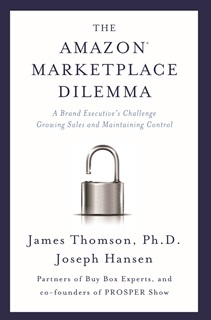
The book begins with two questions for brand executives:
- Will the brand’s products be sold on Amazon?
- If so, what distribution approach gives the brand the best chance of maintaining profitable control?
For popular brands, the first question frequently cannot be answered solely by the brand. Open marketplaces allow inventory to reach Amazon through many paths.
The more consequential decision is how the company chooses to participate.
We described that choice as the Amazon Marketplace Dilemma:
Sell TO Amazon
versus
Sell ON Amazon
That choice affects much more than where an order is processed. It can influence pricing, inventory, customer experience, operational responsibilities, channel economics and control.
The terminology has evolved, but the underlying governance issue has not.
Boards should understand how the structure of a marketplace relationship changes the economics and dependencies of the business.
Explore The Amazon Marketplace Dilemma
Related EVA resources:
Controlling Your Brand in the Age of Amazon: The Brand Executive’s Playbook for Winning Online
Whitney Gibson and James Thomson, Published in 2020.
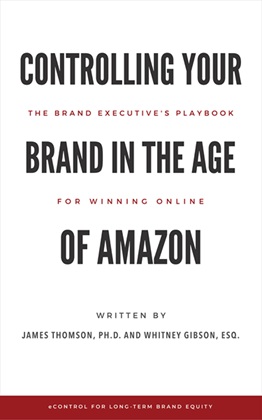
By the time we wrote this book, the marketplace challenge had become increasingly clear.
Many brands did not know:
- who was selling their products online
- where unauthorized sellers obtained inventory
- how distributor inventory reached marketplaces
- how channel leakage affected pricing
- who controlled marketplace content
- whether commercial policies supported the brand’s intended strategy
The issue was not simply an Amazon problem.
It was a governance problem involving distribution, incentives, authorization, inventory and accountability.
Those questions are even more relevant when a company is PE-backed or approaching a transaction.
A buyer will eventually ask whether the company actually controls the systems responsible for marketplace economics.
Explore Controlling Your Brand in the Age of Amazon
Related EVA resources:
How My Thinking Has Evolved
When I wrote these books, much of the discussion around Amazon centered on marketplace strategy and operating control. I now view many of the same issues through a board lens.
Consider unauthorized sellers.
At the operating level, the immediate question may be how to remove a seller.
At the governance level, the better questions are:
Where did the inventory originate?
Which incentives allowed it to move?
Is excess inventory contributing to the problem?
Who owns the underlying distribution system?
What are the consequences for contribution, retailer relationships and enterprise value?
The same evolution applies to Amazon concentration. The relevant board question is no longer simply what percentage of revenue comes from Amazon. It is how much of the company’s contribution, demand generation, inventory velocity, customer discovery and operating capability depends on the platform.
The books focused on marketplaces. The work has increasingly become about governance.
Continue Exploring
- James Thomson
- Board Member for PE-Backed Companies
- Marketplace Governance
- Amazon Concentration Risk
- Channel Control
- Media & Speaking
From Marketplace Control to Agentic Commerce
The marketplace-control questions explored in my books now extend to AI systems that may influence discovery and transactions before consumers reach a retailer or brand site. See The Agentic Commerce Control Model.
The Agentic Commerce Brief
What changed in agentic commerce, and what it means for brands.
A concise weekly brief for brand executives navigating the shift from human-led shopping to agent-mediated commerce. Follow the developments that matter, the implications for brand control and governance, and the questions senior teams should be asking now.
Read The Agentic Commerce Brief on SubstackIf the signup form does not load, subscribe directly on Substack.